
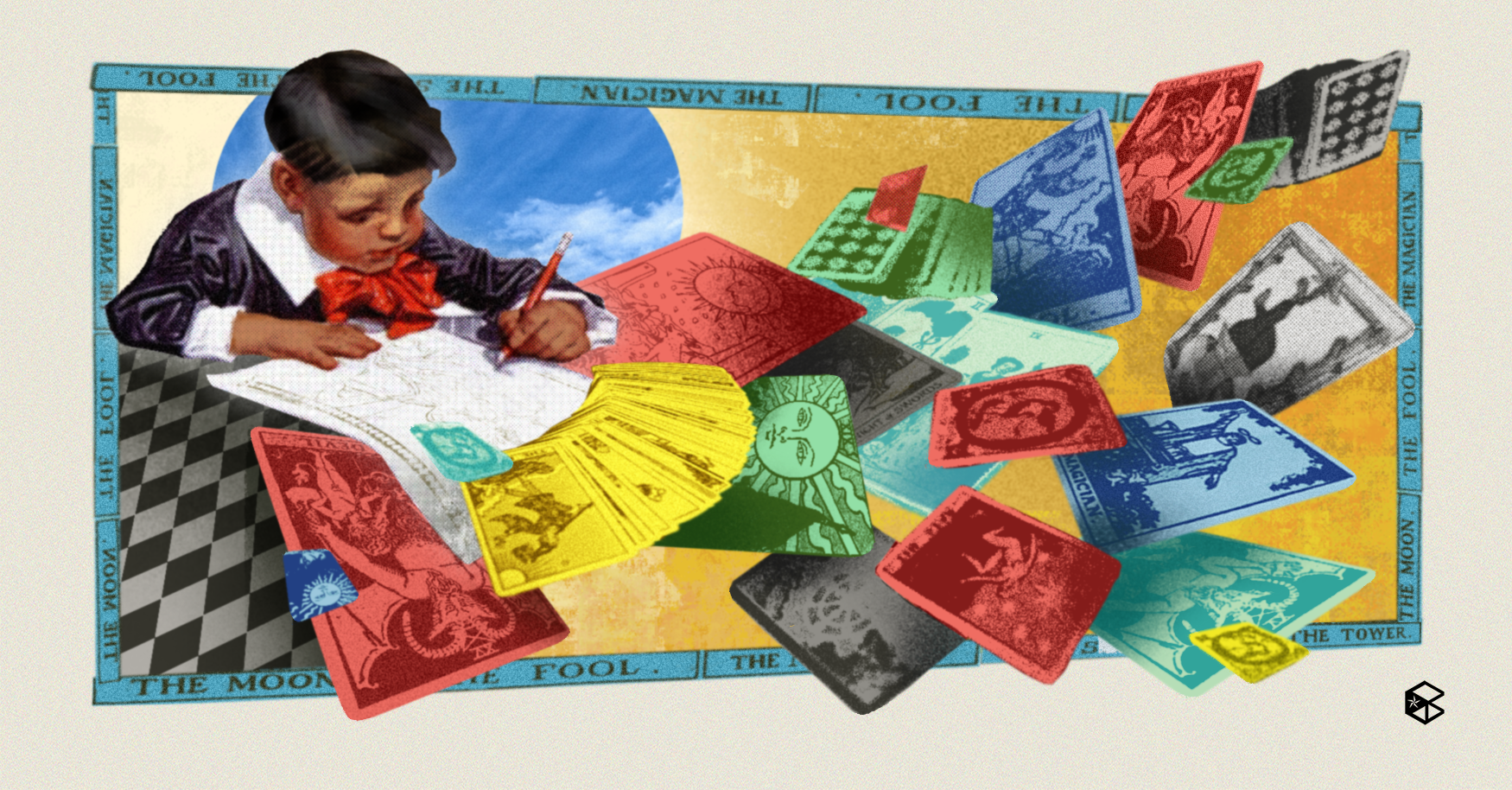




A tarot deck primarily holds 78 cards, each one representing a different story—each piece of art carefully curated to either stand alone on its own or connect to create one tale. When it comes to tarot cards, individuals often focus on the reader and the message, many fail to acknowledge the physical presence of the cards—the art behind their prophecy.
According to the Victoria and Albert Museum in the UK, the exact origin of tarot cards is hard to pinpoint, but it can be traced back to the early 12th century in various countries across Asia and Africa. The cards entered Europe in the 15th century, leaving behind four hand-painted and gilded Italian cards by Italian artist Antonio di Cicognara. The Met Museum reports that during the same period, the cards were used as a trick-taking game before eventually evolving into what we now know as a tool used in taromancy in the 19th century.
Cards that tell a tale
The late Brenda Fajardo is a renowned Filipino printmaker and painter known for her work centering around social issues, the colonial history of the Philippines, and advocating women’s empowerment. Other than that, Ms. Fajardo also opened the gates to using tarot cards as an artistic medium. According to research published in 2024 by Ms. Iris Ferrer on the website of the Archives of Women Artists, Research & Exhibitions (AWARE), “The recurring use of tarot cards has been a signature in B. Fajardo’s works.”
The artist created, “Baraha ng Buhay Pilipino” and “Baraha Sang Pangabuhi,” a series of acrylic work on a canvas that showcases Filipino modern-day issues. Ms. Ferrer mentioned in her published piece that, “She [Ms. Fajardo] poses the tarot cards as directions, guiding the men and women in the images she created in what it means to be Filipino.”
Aside from Ms. Fajardo, other Filipino artists have produced work inspired by taromancy. Fashion Design and Merchandising (AB-FDM) alumna Ms. Kim Kathleen Chua has created a stunning collection, “THREADS OF FATE” which was featured in SINULID 2025, an annual culminating show for AB-FDM graduates. Ms. Chua’s pieces were said to draw inspiration from taromancy, where even the smallest details showcased the mystical story-telling that tarot is known for—in this case, the designer’s journey of self-discovery.
The Filipino arcana
When it comes to actual tarot decks in the Philippines, tons can be purchased through online and even physical stores such as Fully Booked. One of the most notable tarot products that the store offers is “Sinagtala,” a deck produced by fictionminds, a company that started as a passion project, creating compelling products to promote local folklore and mythology, and designed by the founder, Mr. Augusto Ayo.
In its trademark, “Sinagtala” consists of 85 cards each representing a piece of Filipino folklore—taking him over two to three years to finish the illustrations. These stories vary from horror myths that evoke an eerie feeling and majestic mythological creatures that evoke awe from enchantment.
In an interview with The Benildean, Mr. Ayo shared the process of creating the collection, “I partnered with Filipino writers who are well-known for their works on Filipino folklore and mythology… they were the ones who recommended the character for the cards, my process was just to imagine and do a little bit of research… then do my own interpretation for the artwork.” He also mentioned his difficulties to illustrate unknown characters “since there was not enough information where I could find the official look of [other] characters.”
As a person who does not practice taromancy, Mr. Ayo deems tarot cards to be meditative, a tool that one can use to feel more empowered not just through the readings but the art itself, “It's one way of inspiring, getting inspiration from maybe promoting or bringing up your own thoughts when you're looking at each card or as a whole.”
Other than that, these cards are also functional, “[...] I do see them as tangible… because usually the traditional art that you can just view on the wall. But here, there is a function. You can shuffle it, you can hold it and then do some readings and then you can maybe play with it or something,” Mr. Ayo added.
The art of storytelling
From the perspective of an actual cartomancy practitioner, ID123 student Vinni "Viri" Alvarado from the Fashion Design and merchandising (AB-FDM) program shared her insights in an interview with The Benildean when it comes to choosing tarot decks, "Some of my decks, I've gotten from re-homing, it has been gifted to me by a friend, the others I bought because… I like the art, and I felt like I was being called to,” expressing the heavy influence of the art and story on the cards. ‘I'm actually planning to get ‘The Stained Glass’ tarot deck because the art captivates me.”
For Alvarado, taromancy is a form of art, whether it be through reading or designing, “[...] many people design and illustrate tarot decks… Aside from visual art, there is also a form of storytelling through divination, because you are interpreting symbols and connecting them in new ways. So, you express them through your words and tone.”
Interpretation of the messages and storytelling that a card produces is heavily similar to interpreting a series of displayed works in a museum and a newly released film in the cinemas—they are all up to the viewer's interpretation. “These interpretations or how we appreciate these art forms are unique to us or the viewer,” Alvarado added.
“As a fashion student, fashion is not just all the glamour, runways, models, photoshoots—It's also trying to convey a story. Especially if you're a designer, na avant-gard… to convey a story through your garments… and I think that goes well hand-in-hand with taromancy because you're also telling a story through the cards,” Alvarado expressed when asked how the practice has influenced her own art.
Tarot cards may be a renowned tool for divination, however, it is also important to start appreciating it as an art. It may be subtle but the influences that it currently has in the art scene is undeniably strong, Alvarado conveyed, “I personally see a lot of different artworks on tarot cards like the moon or the star being drawn in different ways. Even as tapestries, posters, some even get them as tattoos which I can say the same for some paintings or films or even [designs] of cartoon characters or anime especially with their symbolisms and designs.”
The practice of cartomancy should not hinder anyone from creating art, “[...] Anyone can do it as long as they have something to say or a goal… anyone can have a potential in doing this exploration and creating their own decks, It's just based on inspiration. [...] I just want to promote what I've said [which is], to create something,” Mr. Ayo emphasized.
No matter the medium, where it can be seen or how it was made—if it has a genuine story to tell, it is a compelling art that deserves recognition.
