
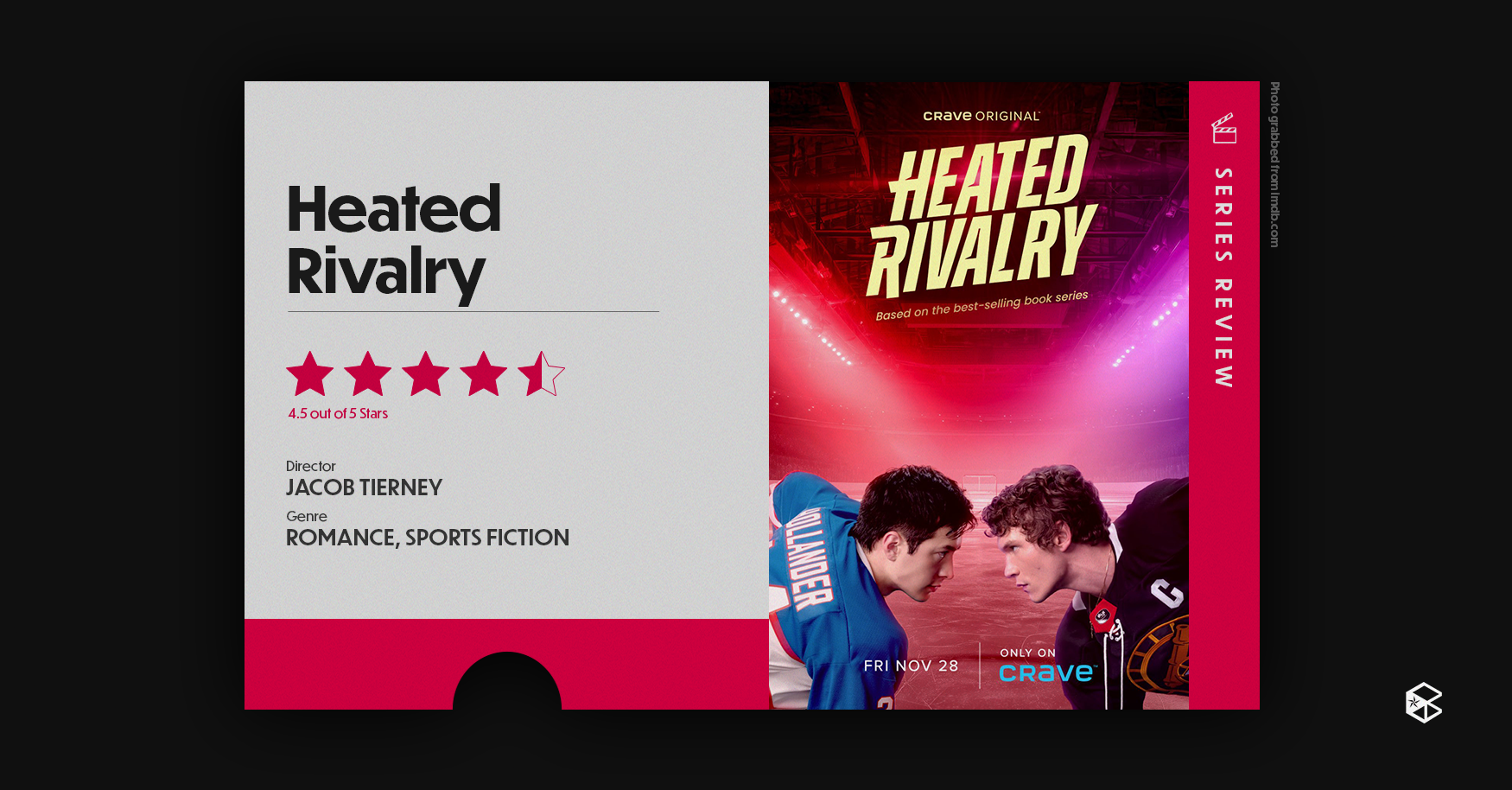




“Heated Rivalry” breaks the ice as a groundbreaking streaming event, shattering every assumption about LGBTQIA+ stories in professional sports. Released on Nov. 28, 2025, and directed by Jacob Tierney, this passionate series adapted from Rachel Reid's beloved novel both scores and completely changes the game, diving into the forbidden romance between two National Hockey League (NHL) rivals whose connection burns hotter than any championship trophy.
The story follows Shane Hollander (Hudson Williams), an Ottawa-born Japanese-Canadian captain of the Montreal Metros, and Ilya Rozanov (Connor Storrie), who compete on rival teams. What began as an on-ice rivalry amplified by media coverage, slid into something far more dangerous: a private relationship that spans eight turbulent years.
While their professional animosity plays out under the bright lights of packed arenas, behind closed doors they grapple with feelings that could cost them everything. One skates as the hometown hero, the other plays the antagonist, but both must navigate a league—and a world—that demands they keep their truth on ice.
Rules of the game
Heated Rivalry’s technical execution is a masterclass in resourceful storytelling, extracting maximum impact from minimal means. The show wrings every ounce of production value from its limited budget, delivering a series that feels far more expensive than its budget would suggest—a testament to how creative ingenuity thrives when passion fuels a project.
The cinematography makes a bold statement from the very first frame: This is cinema, not just television. Shot in a widescreen aspect ratio typically reserved for feature films, Heated Rivalry signals its cinematic ambitions by painting the scenes in naturalistic tones that feel refreshingly lived-in. The visual approach embraces intimacy, transforming locker rooms and hotel corridors into spaces that breathe with authenticity.
Every frame feels tactile and immediate, pulling us into Shane and Ilya's clandestine world with uncommon closeness.
Puck is in your court
Confident restraint is the backbone of the series' script and direction. The economical dialogue reveals character through subtext rather than exposition, infusing all conversation with double meanings. Meanwhile, the scenes are directed in a way that unfolds with patient precision, resisting the urge to over-explain or rush emotional beats.
The directors understand that tension builds in the spaces between words, in lingering gazes and the choreographed near-misses. This measured approach shows that it trusts its audience, allowing silences to speak volumes and letting the actors' expressions carry the narrative weight, while giving it space to develop organic complexity.
Yet the show stumbles significantly in its pacing—not from languishing, but from being too fast. Eight years of nuance and story has been crammed into a mere six episodes, leaving viewers whiplashed by the jarring time skips that fracture narrative cohesion. The relentless forward momentum bulldozes emotional development that deserves careful cultivation. This breakneck pace robs the story of breathing room, leaving crucial beats feeling rushed and undercooked.
Coming out of the locker room
Most dramas of the sports genre simply flip the script by making the underdog the hero and the favorite the villain. But “Heated Rivalry” does not merely hover within those boundaries; it dismantles the assumptions that have long kept LGBTQIA+ stories on the margins of mainstream entertainment. The two protagonists are not opposites but rather parallel trajectories through the same hostile system.
This dynamic creates the series' most compelling tension. Ilya and Shane's carefully constructed public personas and their private desires are both performances, both lies, both truths, suggesting that the binary of straight and gay in professional sports can be a tool of control that punishes those who refuse to perform palatability.
This is a meditation on male vulnerability and its limitation in hypermasculine spaces. The protagonists represent two sides of an impossible choice: to be free, to be successful, or to be yourself. Their relationship is the emotional anchor—a visceral display of what could have been a simple romance in an ideal world, emerging into an examination of systems that demand men choose between authenticity and belonging.
Additionally, the series' impact skates beyond just the screen. Hollywood executives, long convinced that LGBTQIA+ sports narratives were too niche for mainstream success, now find themselves reconsidering their calculations. The casting of unknown actors—fresh faces unburdened by the weight of famous last names or industry connections—has proven that talent and chemistry matter more than recognition.
Perhaps most remarkably of all, “Heated Rivalry” has sparked conversations within professional sports about homophobia and the pressure athletes face to conform to an outdated masculine ideal. Of course, hockey culture hasn't transformed overnight, but the show has given athletes and fans a way to discuss inclusion in ways that feel organic rather than preachy.
Love, unbenched
The cultural significance of “Heated Rivalry” extends far beyond its runtime, resonating in ways that transcend entertainment to become a genuine cultural touchstone. In an industry where LGBTQIA+ narratives have historically been relegated to either tragedy or tokenism, the series is radical for being a story that dares to imagine joy.
Representation does not end with visibility alone—it only begins with the opening of possibility. For decades, queer audiences have watched their stories unfold with grim predictability. This narrative pattern has reinforced a pernicious myth that queer love is inherently doomed, that authenticity comes at the cost of happiness.
But the arrival of “Heated Rivalry” dismantles this tired formula with chillingly cold defiant optimism.
By allowing Shane and Ilya to claim not just love but a future—complete with the messy, imperfect contentment that heterosexual narratives take for granted—the series offers hope.
It has also shed light on the power of community and belonging. Online spaces have erupted with fan art, analysis, and personal testimonials from viewers who see their own experiences reflected in Shane and Ilya's journey. Closeted athletes have found solace in watching characters navigate the same impossible choices they face daily. Older LGBTQIA+ viewers have expressed tearful gratitude for finally seeing the story they wish had existed when they were young.
The show has become a gathering cottage, with its own shared language for discussing identity, along with the courage required to live authentically in spaces designed to punish difference. In giving Shane and Ilya their hard-won happiness, “Heated Rivalry” offers its audience affirmation that their stories deserve satisfying conclusions, that representation without hope is hollow, and that sometimes—against all odds, despite every obstacle—love wins.
Control the puck into the direction of love with Heated Rivalry, available for streaming on HBO Max. Remain seated and keep warming those benches because Season 2 is officially announced to be in the works.
