
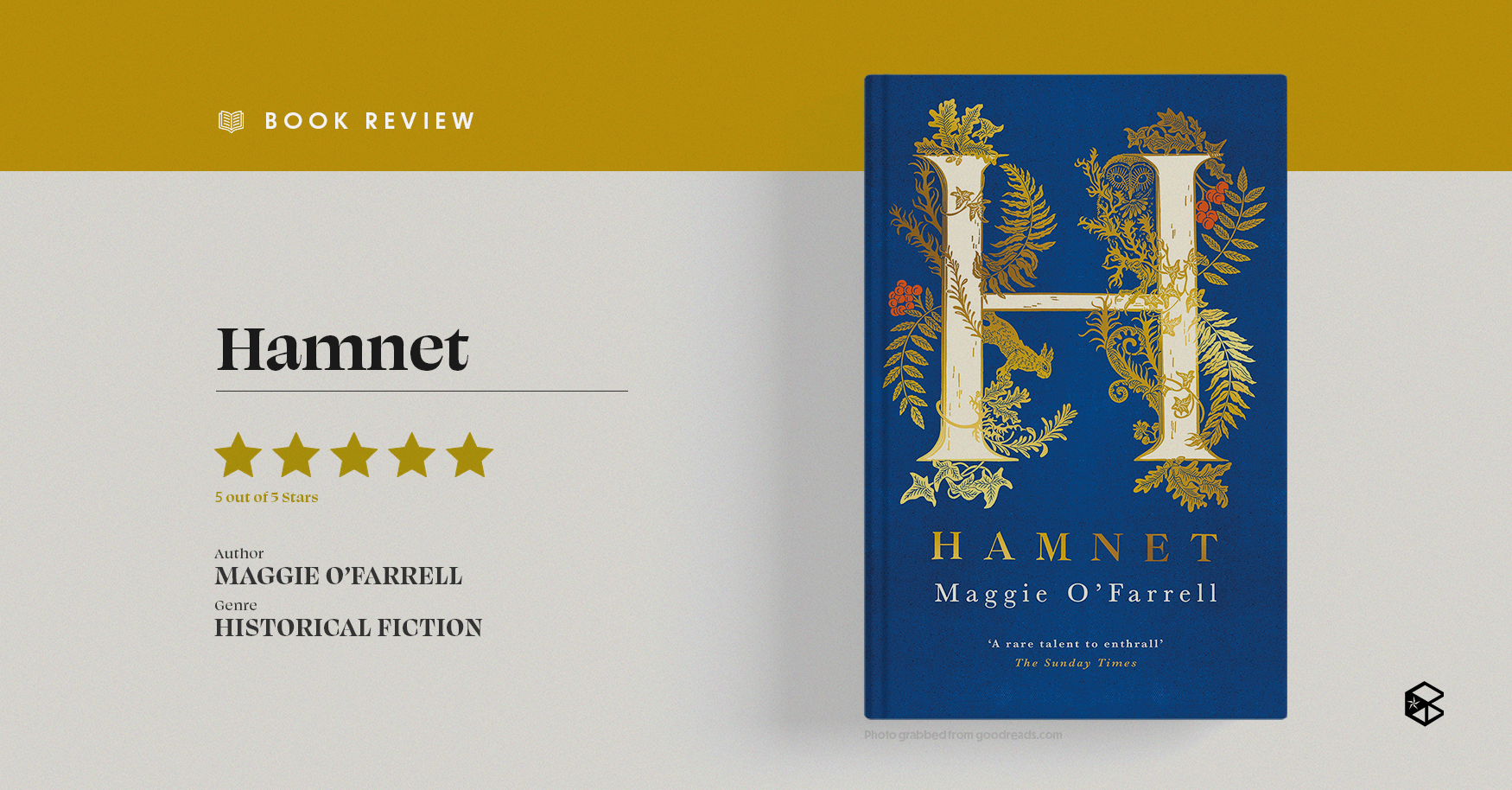




Title: Hamnet
Author: Maggie O’Farrell
Genre: Historical Fiction
Rating: 5/5
Maggie O’Farrell’s “Hamnet” is a fictional account of William Shakespeare and Anne Hathaway’s son, Hamnet Shakespeare, who died in the summer of 1596 at age of 11—a story of a boy’s short innocent life now immortalized in classic literature.
Hamnet Shakespeare’s death is labeled a historical mystery. His burial is listed but not the cause of his death. Four years or so later, his father wrote a play called Hamlet, which will be widely considered as one of the world’s most powerful and influential tragedies ever written. Meanwhile, Hamnet is a tender reimagining of a beloved boy whose life has been all but forgotten, but whose name was given to one of the most celebrated plays ever written.
Catalyst or fate?
How different and easy life would be if one could foretell future events at a whim. Anne Hathaway—named Agnes Hathaway in the novel—is portrayed exactly as such: a seer with a healing hand. Visions haunt and bless her with each passing day, maladies and melancholy fled from the effect of her herbs and poultices, touch alone permits her to sift through a person’s mind and uncover their deepest secrets. Yet, the worst of tragedies deemed unimaginable to a parent has wound its way into the threshold of her home, unforeseen, even by her.
The Black Death or “pestilence” is not mentioned once by Shakespeare in any of his writings despite living through the height of it, leading to the author’s speculation of the plague being the perpetrator for Hamnet’s death. The plague becomes an integral part of the novel, dressing itself up as a robber in the night, knocking on doors to ambush those who would dare answer.
The story poses a question through Agnes’ experience: How do you accept something that is beyond your control? As human beings, we claw and grasp for sense. Even in the midst of an unexplainable situation, we long for understanding. Our mind, fueled by the heart, generates questions that demand and taunt; desperate cries for an encircled answer. O’Farrell challenges Agnes in the novel by pushing her to answer the question of fate.
If fate comes knocking at your door and demands for the life of the one you love, would you still let it in? How do you respond? How do you hold it off, knowing you can’t?
Grief is love
In the novel, the concept of death takes on the allegory of a lit room placed in the middle of an expanse of moorland. The living inhabit the room while the dead mill about outside, pressing their hands and noses to the window—a futile attempt in reaching out to communicate one last “thank you.”
“She now knows that it’s possible that one of her children will die…But she will not have it…She will place herself between them and the door leading out, and she will stand there, teeth bared, blocking the way.”
Loss is inherently tied to love. Without loss, love becomes unrealized. O’Farrell’s prose is well-executed all throughout, excellently giving full depth and meaning to one of humanity’s darkest cloud: death. It does not shy away from the honesty and vulnerability that comes with the meticulous exploration of a parent's unrelenting love for their children. Her words weave together seamlessly, giving the reader a glimpse of a feeling that will never be completely understood in its entirety unless lived through personally.
It is wonderful to realize how love—at its highest peak—pours out in a strong and heavy flow like that of water breaking through a dam. It drags a path through barren lands and dried-out river beds, giving birth to permanent transformation that will live on for future generations to marvel at.
At the end of the novel, a grief-stricken Agnes hears talk of a new play written by her husband, who is well-known for his excellence in comedy. A play with a name extremely similar to that of her late son. Hamlet. She travels to London, expecting a mockery of the most sacred of names for the sake of theatrics, only to witness the most profound translation of the inner workings of her husband’s heart.
“Her son, her Hamnet or Hamlet, is dead. Yet this is him, grown into a near-man, as he would be now, had he lived, on the stage... speaking words written for him by her son’s father.”
William Shakespeare's Hamlet, his tribute to Hamnet, lives on to this day. The name, now immortalized by an act of love, would outlive that of his siblings and parents. A name that we all came to know has—like all things beautiful—also once felt the warm touch of loving hands.
Maggie O’Farrell’s “Hamnet” is a stark reminder of what love is, what it does, and what it leaves behind.
“Hamnet” is sold physically in Fully Booked. It is also available online through Amazon and Fully Booked Online.
