
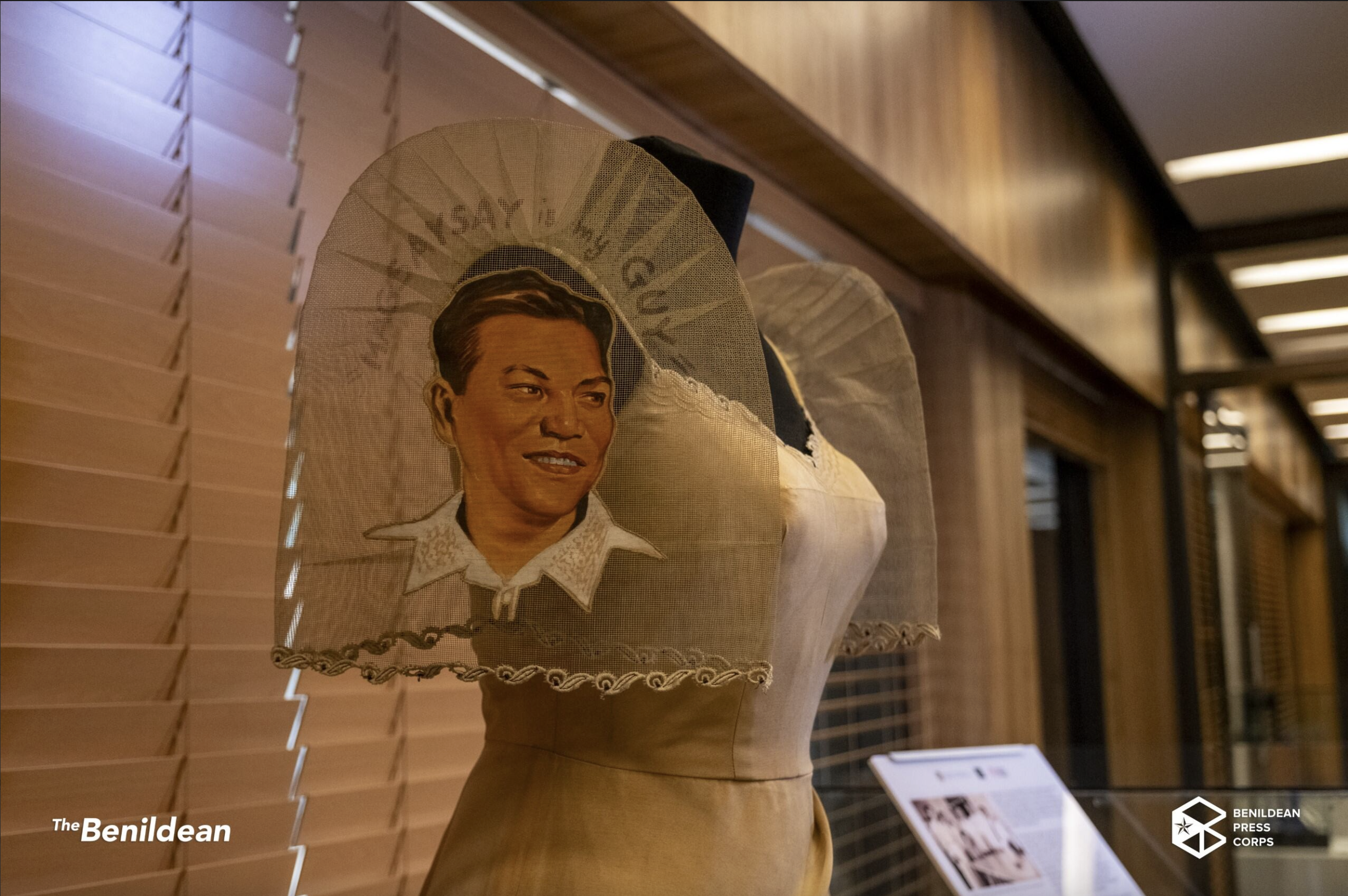




The Ramon Magsaysay Award Foundation (RMAF), in collaboration with DLS-CSB’s Benilde Fashion Museum (BFM), invites everyone to “Magsaysay as Muse: Luz Banzon Magsaysay and the Terno as Cultural Identity.” The exhibit featuring seven archival Ternos from renowned couturiers, Aureo Alonzo and National Artist Ramon Valera, worn by the late First Lady will be open to the public until March 27 at the Magsaysay Laureate Library and Museum, Ramon Magsaysay Center.
Alongside the exhibit will be a lecture series on the life and legacy of Mrs. Luz Banzon Magsaysay and the cultural significance of the garments and its designers on display:
“Preserving Culture and Heritage: The Benilde Fashion Museum” with Ar. Gerry Torres on Feb. 26, 2 p.m. to 4 p.m.
“Ramon Valera: National Artist for Fashion Design” with Eric Pineda on Mar. 26, 2 p.m. to 4 p.m.
Greatness worn with grace
The exhibition officially commenced as Ms. Susan Afan, President of the RMAF, delivered an opening speech, providing background on the RMAF. “The Magsaysay legacy is all about integrity, courageous leadership, selfless service—collectively, greatness of spirit.” Often coined as the “Nobel Prize of Asia,” the RMAF honors those who embody these values across the fields of government service, public service, community leadership, journalism, literature and creative communication arts, peace and international understanding, and emergent leadership.
In line with this, the exhibition extends these ideals in the realm of fashion and culture. Mrs. Magsaysay’s legacy has been widely praised as a model of simplicity, grace, and integrity, and through her Ternos, this embodiment of quiet strength and dignified modesty radiates. More than just a garment, the Terno became a symbol of Filipina identity and cultural pride that exudes the greatness of spirit that figures like the late First Lady uphold.
Where fashion meets heritage
Ar. Gerry Torres, Director of BFM and curator of the exhibit, shared in an exclusive media preview with The Benildean how the BFM came to be. “It started with a gift from the family of the late Ben Farrales, one of our foremost fashion designers, when his family contacted Benilde with an offer to house 350 garments because they learned that we have a fashion design program.” A generous decision from the family to connect the collection to education.
The donation laid the foundation for what would become a growing archive dedicated to preserving Filipino fashion heritage. The BFM is situated at the Miguel Febres Cordero (MFC) Building of the College’s Taft campus. Among the archives were iconic Ternos worn by Mrs. Magsaysay. Truly a case of fate and aligned stars, the collaboration between RMAF and BFM felt like a true homecoming, as these garments transpire in a space dedicated to honoring greatness of spirit and selfless service, named in honor of her husband’s legacy.
Fashion through time
The intimate arrangement allowed for Ar. Torres to give a tour of the exhibit, showcasing the detailed craftsmanship practiced by the renowned designers, “If you look at the quality of the beadwork, no single bead is missing.” He also highlighted the expert draping and innovative construction of the gowns, as seen in the works of Alonzo and Valera, and how these pieces have managed to retain their form even after all these decades.
It is worth noting that, after decades, some gowns inevitably show signs of wear and tear. The decision to not conceal these flaws is a deliberate curatorial choice as Ar. Torres explained, “Normally in museum practice, it is frowned upon to exhibit compromised artifacts. But in this case, we decided to show them as we received them to underline the urgent need for scholarship and expertise in textile conservation in the country.”
For now the museum is letting them remain as it is until further advice and guidance from conservation experts can be obtained.
More than a gown
The Terno stands as a symbol of Filipina culture and identity, “You are not just looking at design, but you are also looking at the Terno as a symbol of our culture,” Ar. Torres said. In post-war Philippines, Mrs. Magsaysay actively promoted the Terno, wearing it with conviction from daytime events to evening galas, echoing her husband’s vision of rebuilding the nation and shaping Filipino identity.
Her figure made her an ideal muse for designers, particularly Mr. Valera, whose expertise transformed the 19th century four-part ensemble Traje de Mestiza–with the camisa (blouse), skirt, and tapis (overskirt)–into a single garment using the invention of the zipper. Valera also refined the pañuelo (shawl) by transforming it into butterfly sleeves, elevating it into a hallmark of Filipino couture.
Celebrating Filipino genius
Filipino fashion designers have shown craftsmanship beyond recognition in ways often failed to be noticed by the public. “For many years, we've overlooked that the creations of our mid-century designers are actually valuable artifacts, not just for study, but also as a reflection of the creativity of the Filipino designers through the years,” Ar. Torres shared.
The exhibition and the BFM serve as a reminder of how Filipino craftsmanship not only upholds tradition but also exceeds expectations in artistry and meticulous attention to detail.
Stay up to date with the latest on RMAF’s Facebook, Instagram, and official website, as well as BFM’s Facebook and Instagram pages.
