




What began as a routine audit of missing or ineffective infrastructure has metastasized into an international controversy involving billions of pesos in public funds, lawmakers, and criminal investigations. As calamities continue to plague the country, the scandal has become both a governance and human crisis, raising urgent questions about accountability, political will, and the true cost of greed.
Hundreds of projects nationwide were reported as “completed” in official records despite being missing, unfinished, or substandard. Department of Public Works and Highways (DPWH) Secretary Vince Dizon later confirmed that out of 8,000 projects reviewed, at least 421 were validated as “ghost projects.”
Public scrutiny intensified after President Ferdinand ‘Bongbong’ Marcos Jr. (PBBM) condemned the anomalies during his 2025 State of the Nation Address (SONA), followed by surprise inspections—including a widely publicized visit to a ₱56-million flood control structure in Bulacan—where there was little to no infrastructure.
A network of greed
Congressional probes and hearings soon traced the anomalies to a concentrated network of contractors and politically-connected intermediaries. It was later disclosed that only 15 contractors cornered ₱100 billion in projects, with many already flagged for poor Construction Performance Evaluation System (CPES) ratings, prior tax or graft investigations, and a history of substandard work.
Lawmakers alleged that some projects were under-engineered, allowing firms to cut costs while reporting completion, with kickbacks shared among patrons. Connections to political figures, in turn, amplified the corruption.
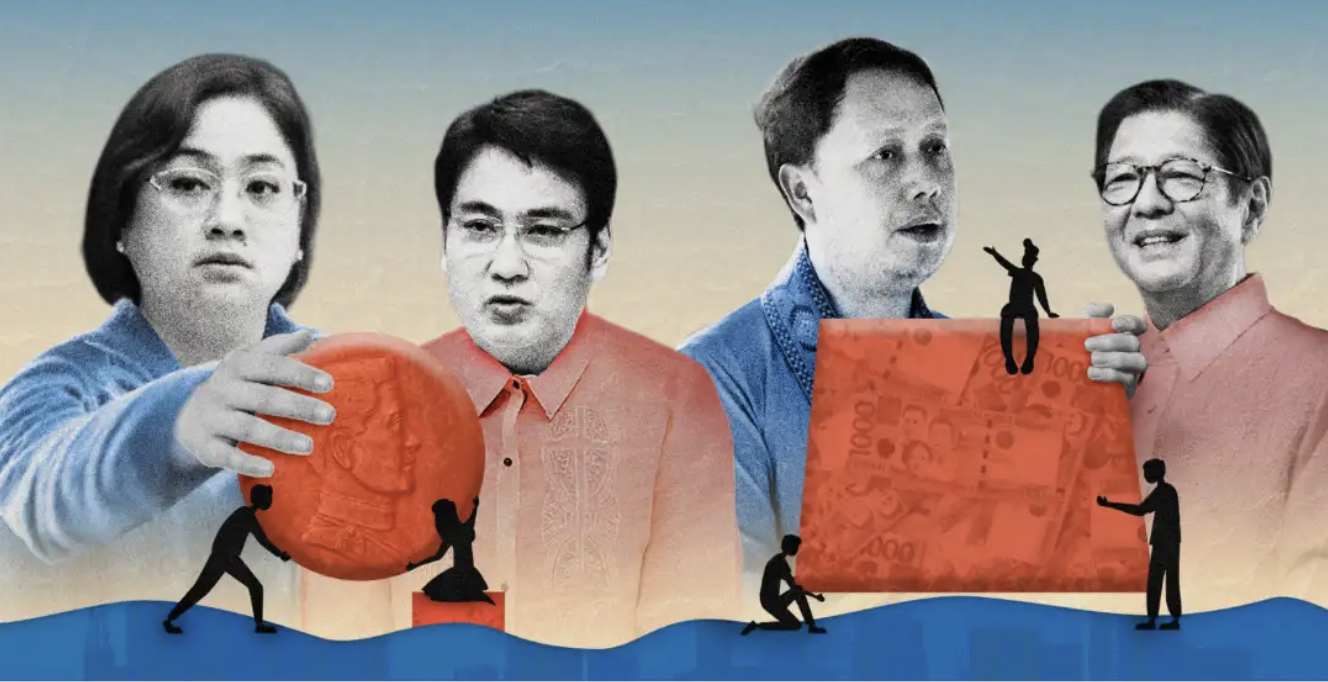
Reports also found 18 members of the 20th Congress had ties to firms benefiting from public contracts. Scrutiny widened to the budget process after legislators flagged a ₱142.7-billion insertion in the 2025 national budget. Civil society groups later noted that insertions surged while Martin Romualdez served as House Speaker and Elizaldy “Zaldy” Co chaired the House Committee on Appropriations (the Co family of Bicol had secured ₱15.7 billion in flood-control contracts).
Both later resigned amid mounting pressure, as authorities sought an Interpol red notice against Co.
Political shielding and uneven accountability
Amid mounting outrage, the Independent Commission for Infrastructure (ICI) was created in September 2025 to investigate irregular projects over the past decade. Chaired by retired Supreme Court Justice Andres Reyes Jr, the commission was granted subpoena powers and access to government records, with authority to recommend criminal cases and asset freezes. The ICI reviewed over 400 flood control projects, including 80 “ghost” projects.
Cracks quickly emerged, after two ICI commissioners resigned, Reyes was left as the sole member, halting official operations due to lack of quorum. Referrals that involved sitting senators stalled on procedural grounds, and critics warned that without prosecutorial teeth, the commission risked becoming another fact-finding body without consequence.
The Office of the Ombudsman ordered the preventive suspension of 16 DPWH officials over projects worth ₱389.6 million. Likewise, the Anti-Money Laundering Council (AMLC) then secured court authority to freeze 135 bank accounts and 27 insurance policies, tracking roughly ₱5 billion in suspicious assets.
By November 2025, PBBM confirmed that seven individuals had been detained—mostly contractors and mid-level officials—while cases involving senior political figures remained under evaluation.
Among the most closely watched arrests was that of contractor Cezarah “Sarah” Discaya, who was detained on Dec. 19, 2025 on charges of graft and malversation of public funds. Her dismissive behavior toward reporters during her arrest became a flashpoint for critics, symbolizing what they described as the entitlement of politically connected actors, even in the face of prosecution.
On Jan. 16, the Ombudsman filed graft and malversation charges against former Senator Ramon “Bong” Revilla Jr., and six others over a ₱93-million ghost project, suggesting that political figures were not entirely untouchable, even if many cases still remain pending as of writing.
As evidence mounted, opposition lawmakers and legal groups filed impeachment complaints against PBBM and Vice President Sara Duterte, citing culpable violation of the Constitution, betrayal of public trust, and failure to prevent or address the large-scale misuse of public funds. Petitioners argued that the scale of the anomalies—coupled with opaque budget insertions and delayed prosecutions—raised grave questions about accountability at the highest levels of government.
However, both efforts failed. The House Committee on Justice dismissed the complaints against PBBM, declaring them “insufficient in substance,” stopping the impeachment process. The Supreme Court also ruled the impeachment complaint against the vice president “unconstitutional,” blocking any attempt to pursue a case against Duterte until Feb. 6.
For critics, the outcome reinforced long-held suspicions: political alliances—particularly within the fracturing Marcos-Duterte bloc—continue to shield the most powerful, even amid extensive documentation of wrongdoing.
The human cost
Beyond courtrooms and committees, the consequences have been lethal. Despite billions of pesos spent on flood control, many Filipinos remain exposed to disasters.
In Cebu Province—where more than ₱50 billion was spent on flood defenses over the past decade—150 people were confirmed dead following Typhoon Tino. Families in hard-hit areas faced sudden, catastrophic flooding that engulfed entire neighborhoods.
Resident Liza Becus returned to her home in Talisay to find it completely gone. “Everything was destroyed, only the flooring remained. Everything was washed out. We have no belongings; my children have nothing,” she said in an interview with GMA Integrated News.
Among the stories that emerged was that of 15-year-old Jayboy Magdadaro who spent an entire day swimming through rapid floodwaters to rescue 50 of his neighbors.
With this, public confidence in the government plummeted. A survey from Pulse Asia reported a staggering 94% of Filipinos believed corruption is widespread. Meanwhile, nationwide protests, dubbed the “Trillion Peso March,” alongside campus walkouts drew Filipinos to unite in calling for genuine convictions and demanding action.
What now?
Government actions have produced movement, but yielded no resolution. Lower-level figures have been charged, while senior figures remain untouched, shielded by alliances and influence.
Investigations are ongoing and some cases are moving toward prosecution. However, questions persist about accountability at the highest levels, particularly regarding those who designed, authorized, and protected theft.
As proceedings move forward, the disclosures so far may be just the tip of the iceberg. Until the architects of corruption are held to account, the cycle will continue.
For now, the case remains unresolved and the question persists: What now?
