
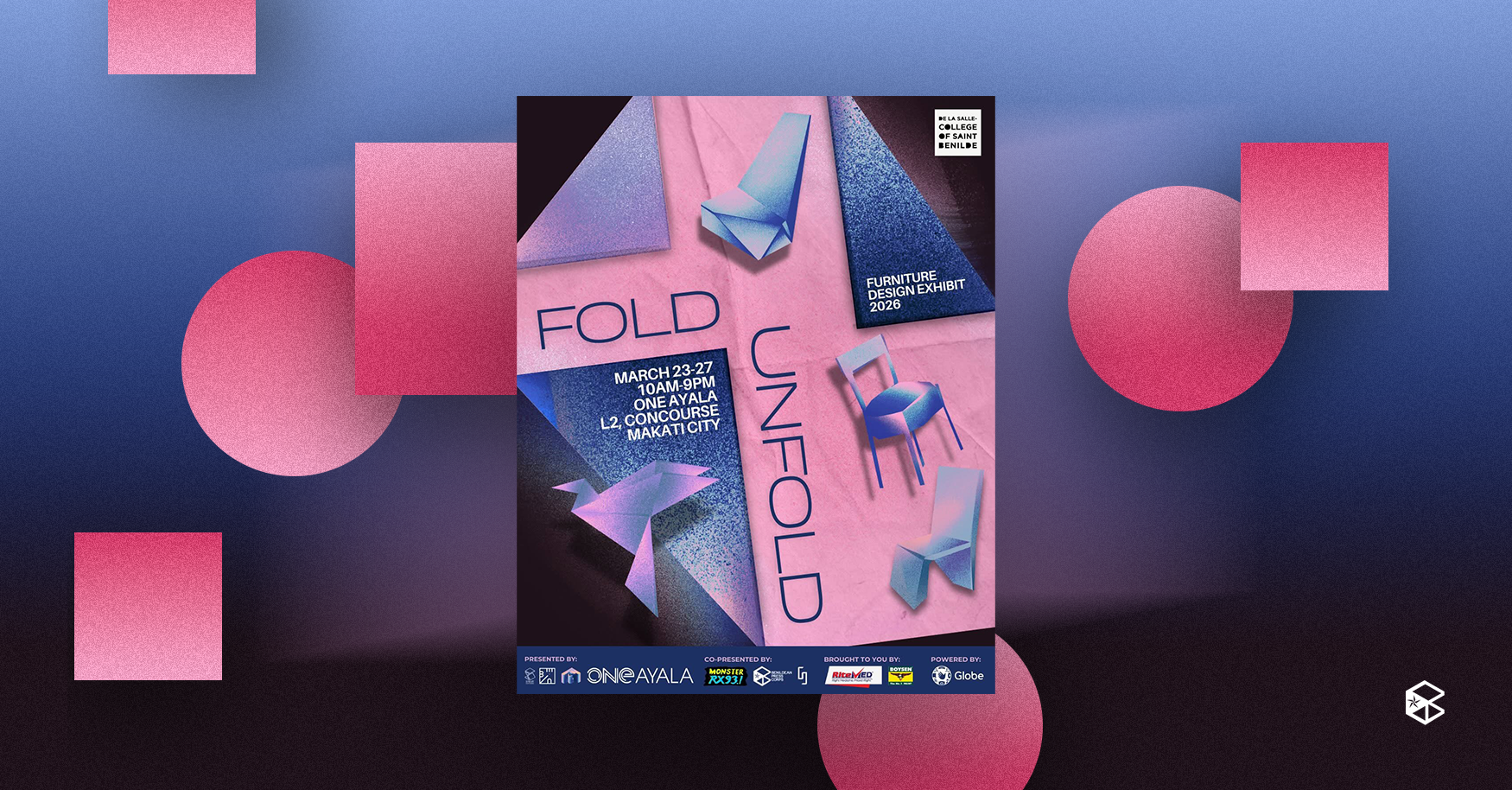




FOLD/UNFOLD: Metamorphic Design for Adaptive Living opened its doors on March 23 at the L2 Concourse of One Ayala, Makati City, and ran until March 27. Free and open to all, the furniture design exhibition brought together student works that sit at the intersection of creativity and forward-thinking spatial design.
The exhibit, presented by BEIN Future Design, a student-led platform dedicated to presenting Benilde’s furniture design exhibits and works as a showcase of how the next generation of Filipino designers, is reimagining the spaces we live in. It offered a glimpse into the minds of emerging designers who see furniture as living solutions, crafted for the way people actually move through their lives. From clever configurations to inventive forms, FOLD/UNFOLD presents student works that fill the room, while rethinking how more it can be.
Where form learns to flex
FOLD/UNFOLD opened with remarks from Ms. Kat Correa, Chairperson of the Interior Design program (BS-InD), who set the tone for the afternoon with a celebration of a program built on an unwavering commitment to design excellence. "At Benilde, we don't just teach aesthetics—we teach our students to craft meaningful human experiences," she shared.
Providing the context behind what visitors were about to experience was IDr. Regina Viola-Caboborac, a registered interior designer and a faculty member of Enderun Colleges, who framed the exhibition as an integral part of the students' design and construction subjects. "In furniture design, our goal is not just to design objects, but to guide them through the process to bring their ideas into reality," she explained.
The theme itself, FOLD/UNFOLD, was introduced as a response to a question growing increasingly relevant in contemporary design: How can furniture adapt to changing needs? "Our students were challenged to rethink furniture, not as static, single-use pieces, but as transformative systems," Viola noted.
The exhibition's articulation process was helmed by Chelsea Sia, an ID124 student from the BS-InD program and the exhibit’s curatorial head, whose approach was rooted in the concept of buni, a traditional art form from Bulacan—drawing inspiration from how a simple material transforms through repetition and movement. Every piece in the space was handcrafted, with easels designed to represent the act of folding and wave flow forms reinterpreted into that of a contemporary visual language.
The thinking behind the folding
Behind every meticulously arranged furniture piece and carefully lit corner of FOLD/UNFOLD was led by Marie Rian Caparros, an ID124 student from the BS-InD program—the exhibit's project head and the person responsible for overseeing every committee. "I'm handling all of the committees and all of the behind-the-scenes here in this event," she shared in an exclusive interview with The Benildean, a role that proved to be as demanding as the theme the exhibit carried.
For Caparros, the concept of FOLD/UNFOLD was deeply personal to the process itself. "FOLD/UNFOLD is really emphasizing our capabilities of the creative mind," she explained, drawing a parallel to origami, where the simple act of folding paper can yield something entirely unexpected. "Unfolding is the fruition of our creative thinking and how our capabilities as designers can propel us towards our future."
Working alongside the exhibit design class to bring the space to life, the experience reinforced something she carried into the event: "It really does take a village to come up with something this grand. It is important that we are not alone in this creative thinking, we are a community of designers after all,” Caparros explained, underscoring that the most meaningful work is never built alone, but through a shared commitment to something greater.
Outside the room
Among the student works that drew the most visitor interaction was the “Eclipse Table,” crafted by Janeeka Go, an ID124 student from the BS-InD program, alongside her groupmates. The project began as a solo coffee table with storage, but gradually evolved into something far more ambitious. "Over time, because we ended up being in a trio, we integrated more ideas—adding the stools and also adding the design," Go recalled.
Looking at the broader exhibit around her, Go saw something promising taking shape in Philippine furniture design. "Everyone has come up with very creative designs, very innovative," she observed, noting that most of the pieces on display felt genuinely new. Meanwhile, her message to fellow Benildeans was equally direct: "Keep pushing for your creative ideas. People will always have criticism for your work, and that should not be a reason to be discouraged."
For Anabelle Aklan, a first-time design exhibit visitor, the showcase was a happy accident, where she stumbled upon it with a friend, but they stayed for the atmosphere. "We were both quite surprised because we usually just go to museums or art exhibitions, so going to a design one like this was quite an experience, and a welcome one at that," she shared.
What struck her most was how the exhibit defied the exclusivity she had come to associate with events of its kind. "Usually these events are very highbrow, very exclusive," she noted, "but going into an exhibit like FOLD/UNFOLD where the design is catered to the use of the Filipino masses was exuberant."
Her takeaway, perhaps said it best: "Grabe ang kamandag ng Filipino designers even though they are just students. Very prepared na for the world stage ang atake." It was exactly the kind of reception FOLD/UNFOLD had set out to receive, one that goes outside of the critics or curators—but to the public it was always meant to reach.
FOLD/UNFOLD may have been a student exhibit on paper, but what unfolded inside One Ayala was a glimpse at the designers the Philippines is quietly producing, the kind of design culture Benilde has spent decades building—and from the looks of it, the best is still unfolding.
Remain seated with what Filipino designers have yet to offer by following BEIN Future Design on Facebook and Instagram.
