
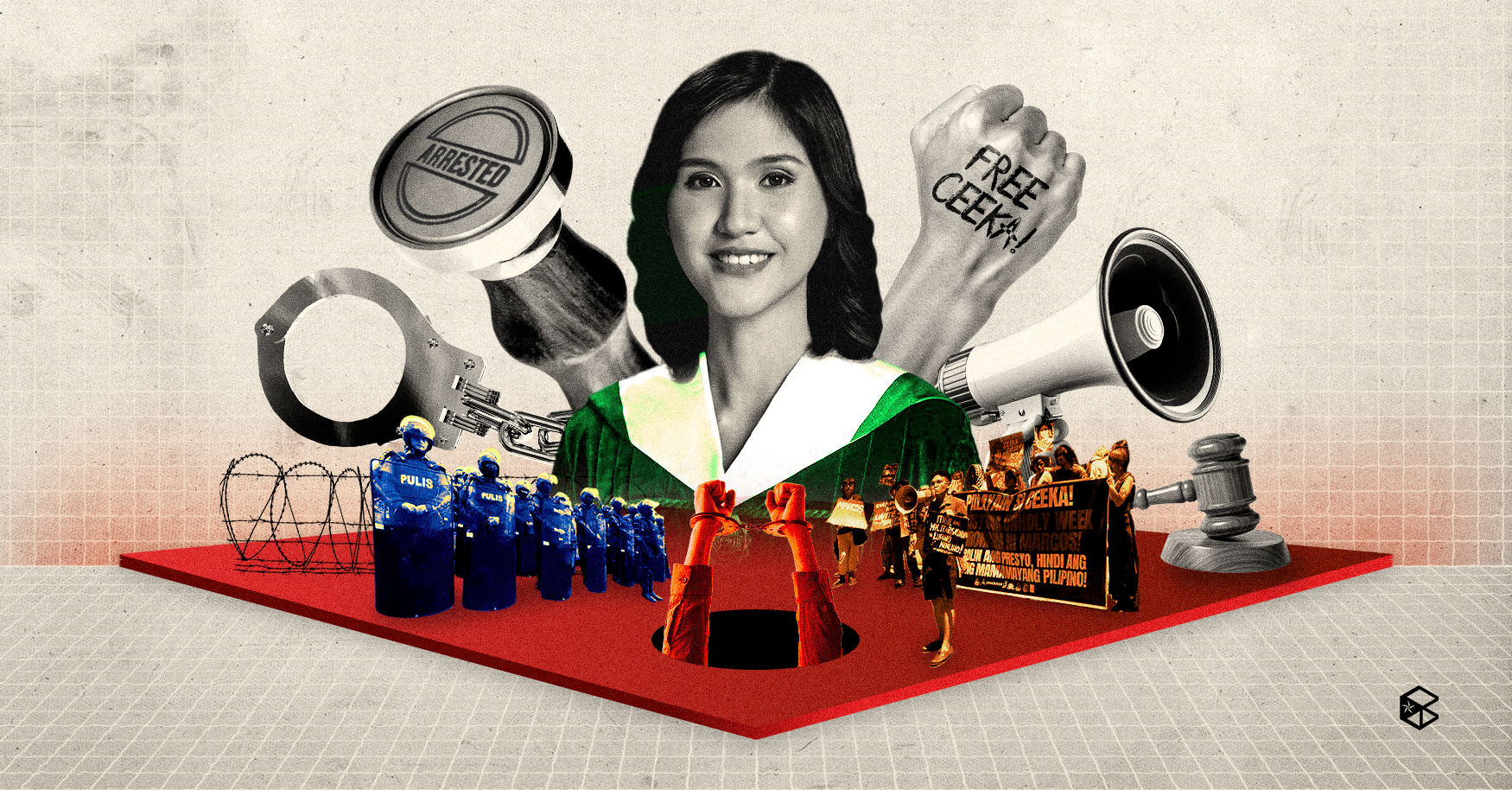




Cultural worker Charlize “Ceeka” Garzon, an alumna of De La Salle-College of Saint Benilde, was illegally arrested and detained by the Armed Forces of the Philippines (AFP) and Philippine National Police (PNP) following an encounter on March 29 in San Jose, Occidental Mindoro.
According to the artist-activist group Anakbayan, she was a volunteer in the Mangyan-Iraya Indigenous Community, choosing to teach and serve within the said community. Various human rights activist groups stress that she is a civilian and not a combatant.
The Philippine Army claimed that Garzon was captured near a fallen Capt. Dean Buen Oyando. On March 31, the family, friends, and paralegals of Garzon went to San Jose Municipal Police Station where she was being detained at the time. However, according to her mother, Mayla “Mayi” Garzon, in a video statement from Karapatan Southern Tagalog, though they were permitted to see Charlize, paralegals were barred from entering with them.
She declined the claims of the Philippine Army that her daughter was in good condition, and raised concerns over alleged harassment that her daughter continues to undergo while in the custody of officers, despite the publicized visitation of their family.
On April 6, Garzon was transferred to the Regional Trial Court where charges were filed. She is currently facing charges of murder and two counts of attempted homicide. As of April 8, Karapatan Southern Tagalog reported the transfer of Garzon to San Jose District Jail.
Reports indicate that her right to due process was compromised when access to legal counsel was restricted, including the barring of paralegals from entering the premises during her custody. Her family also raised concerns regarding a possible violation of the Republic Act 10173 or the Data Privacy Act due to a video posted on the official Facebook page of the Battalion. The video showed the family sharing their vulnerable moments following Garzon’s arrest.
On April 6, various youth activist organizations held a protest in front of Camp Aguinaldo to voice their concern and condemnation of the arrest of Garzon. KAPATID, the support organization of families and friends of political prisoners in the Philippines, also released a statement urging the Commission on Human Rights (CHR) to investigate the said arrest.
KAPATID spokesperson, Fides Lim, stated that, “This designation does not prejudge guilt but underscores a political context that requires heightened scrutiny, transparency, and legal protection without delay and without exception.”
He also emphasized that, “Charlize Garzon—like all persons deprived of liberty—is entitled to presumption of innocence; access to counsel of her choice; humane treatment; protection from torture, coercion, and secret detention; a fair and impartial investigation; and freedom from public shaming or narrative manipulation by State forces.”
One of many
News of engagements between the AFP and the NPA is not new to the public eye. While updates and news reports often come from the official pages of the Philippine Army and of groups or organizations, it remains necessary to provide nuance to the discussion on these issues.
Similar patterns can be observed in the case of Filipino journalist Frenchie Mae Cumpio who was arrested in 2020 following a raid in her living quarters. Initially, only an allegation of illegal possession of firearms was charged against her which was later dismissed. However, she was convicted of terror financing and sentenced to 12 years of imprisonment.
The International Federation of Journalists (IFJ) and the National Union of Journalists of the Philippines (NUJP) condemned the conviction of Cumpio, describing it as a draconian ruling rooted in baseless charges and urging reforms against the use of anti-terror laws to suppress journalists and human rights defenders.
“The conviction of Frenchie Mae Cumpio on baseless charges after almost six years in detention is a highly alarming violation of human rights, a failure of the justice system to protect and uphold press freedom, and a clear effort to silence critical, independent journalism,” IFJ expressed.
In the case of Cumpio, an article from Reporters Without Borders quoted a human rights expert, who requested anonymity, describing the prosecution as “a poorly built case,” characterizing it as “characteristic of red-tagging”—a practice in which civil society actors are falsely linked to the Communist Party of the Philippines and the NPA to discredit and target them.
In past encounters, arrests, and military operations conducted by the Philippine Army in heavily militarized areas, there appears to be a recurring pattern of prematurely identifying individuals in rural communities as members of the NPA. For cases like Garzon, Cumpio, and others who were subjected to the same pattern of events, a narrative appeared to be constructed not through due process or rigorous investigation, but through allegations that lack substantive evidentiary basis.
This is a developing story.
