
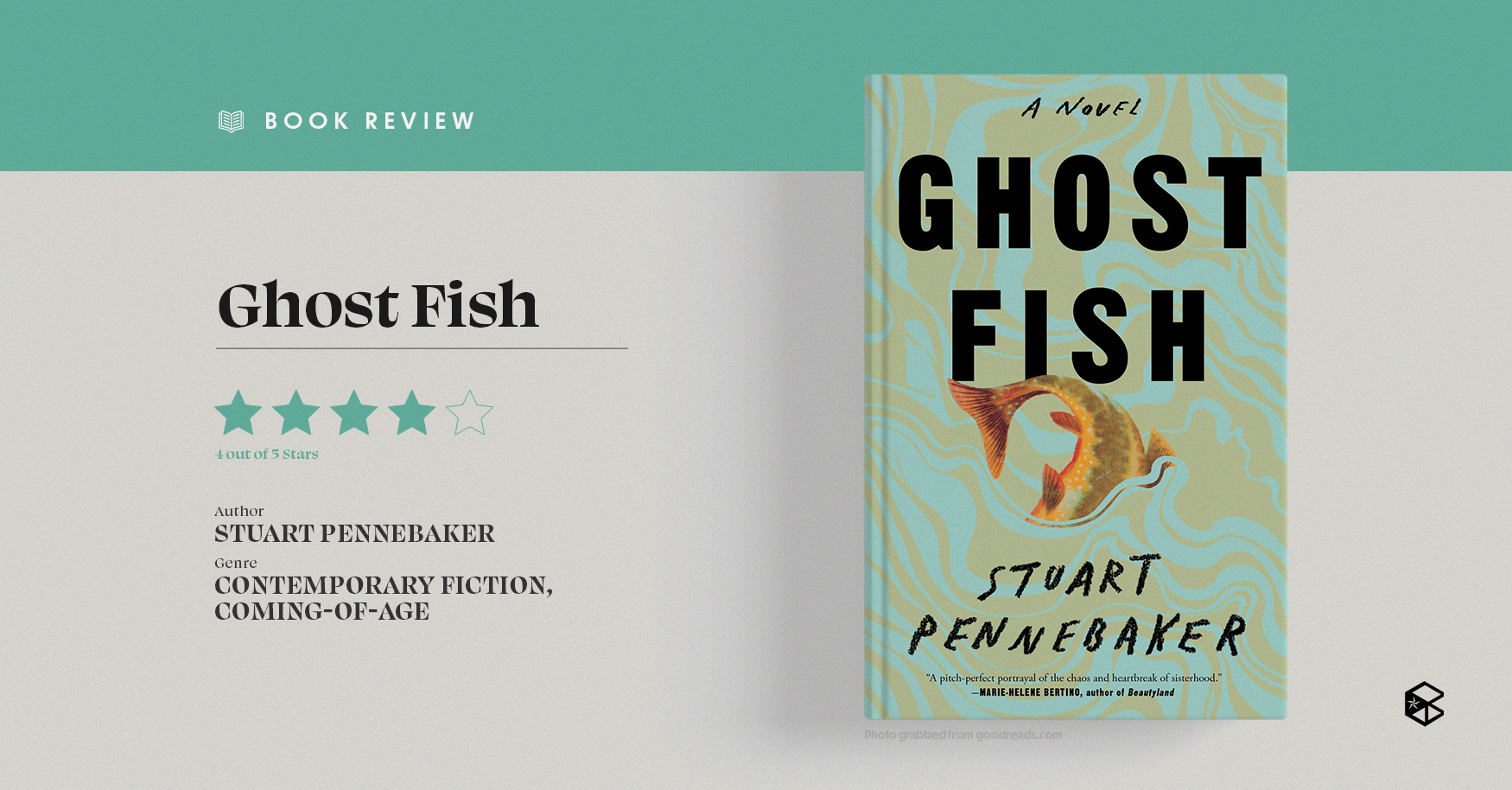




Title: Ghost Fish
Author: Stuart Pennebaker
Genre: Contemporary Fiction, Coming-of-age
Rating: 4/5
Debuting with her first novel, American writer Stuart Pennebaker unwinds the strands of grief and reworks them into a work of art. “Ghost Fish” deals with being alive—in all its trials, tribulations, and messy glory.
The story follows Alison, freshly 23 with a life full of unpacked baggage. She moves into a New York apartment with roommates who all have entire lives of their own. They are an established group of friends and new strangers to her. Her life falls into a whirl of problems, particularly finding connection in this big city. She has nothing to call her own. This loneliness is emphasized by the heavy settlement of loss in her chest—the passing of her sister hits her the hardest.
Throughout the first act of finding her place in the city, Alison finds only fleeting moments of belonging. Late nights were spent with a distant friend she barely knew, lasing over her senses for a boy who typed in proper grammar, and the headiness of alcohol—to distract, to live, and maybe to forget. And after one long night of drinking and a regrettable one-night stand, an apparition appears.
A translucent fish swims around her room—inspecting the space, and especially Alison. The warmth that emanated from its ghostly form was familiar in a way that only she knew. It was there that she knew that this spirit was her sister. From there, that darkness, that emptiness that had resided in her was briefly filled.
Like the tides that Alison has known her entire life and like the ocean her sister drowned in, she learns to navigate the turbulent waters of newfound love, a rift in identity, and the certainty of letting go.
Grief that lingers deep within
For Alison, loss is inborn. It has been a part of her nature, and it has long since followed her out of their small town. It lingered deeply in her thoughts, in her reasoning, and in the heaviness of sunlight in her room. Pennebaker writes this eloquently through memories flashing between present moments and in anxiety-inducing passages through scenarios wherein the main character finally allows herself to feel something other than guilt or grief.
When these sections happen, it is done in a way that allows the reader to tap directly into Alison’s mind. Every step toward a life she wanted to live for herself was triumphant. But she always held herself back. With her sister, in her fish form, having returned to her, Alison finds herself reeling back from newfound opportunities. She gives up a certain sense of control and hands it over to her grief instead, which steers her backwards.
And when love finally comes in the form of her co-worker, Gabrielle, Alison feels as if she is betraying her sister. A visceral sense of self-condemnation gnaws at the main character. She is remorseful and fidgety at being parted from the ghost fish locked in a pickle jar. Her mind spirals down to consequences. She is not able to fully immerse herself in life-changing moments for fear of resentment. And that one day, when she comes back to her room, she might not find her sister there.
Yet as days passed and her spirit's ghostly scales dim, it is her sister who urges Alison to put herself out there. She is the one who encourages her to live. To finally agree to things, to plans, to adventure, to life.
So that Alison would not need to be held down by her dead sister.
And this shadow shall see the sun
It is said that memories can fade with meticulous amounts of mental repression—emotionally and mentally. One can experience the loss of identity through trauma or mental deterioration. Alison forgets herself. She does not exactly know how to reintegrate herself into society. Grief clouds over the sunshine that peeks through the rainy sky.
In the days that she has her ghostly sister back, Alison becomes dependent. She protected her in a way that satisfied any past guilt in not being able to keep her safe the first time. And it is Gabrielle who pulls her out of that grief and gives life to the death in the story. She acts as a constant tether to the real world—full of possibilities and a future outside of the current grief Alison has wrapped around herself. The two develop into something far more than friends—built on more than surface-level strolls through New York and drinking after work.
The more she gets a tenuous hold on that new start, the better she can see how the codependency began to hurt their sisterhood.
It is the unfurling understanding that Gabrielle gives to Alison that finally allows her to see things clearly. The realization comes to her. And she realizes that letting go is her final act of love—to return her sister to the sea that once claimed her.
Ghost Fish is a story about the rawness of emptiness that people leave in our lives. But it reminds us that despite the hole that loss leaves in our bodies, it also speaks of strength. Pennebaker writes to readers about the tender power of letting opportunity come knocking through walls built around our hearts, whether it comes in the shape of a person or of a new city. To let go is a necessary act in taking the next step forward. Free yourself from all the ghosts of the past so that they may no longer haunt you.
One day, the memory of grief will return, but it will no longer hurt as much as it did. And in the pains of loss, remember that you also have to grow up.
Ghost Fish is available at Fullybooked, and it can be bought online through Amazon.
