
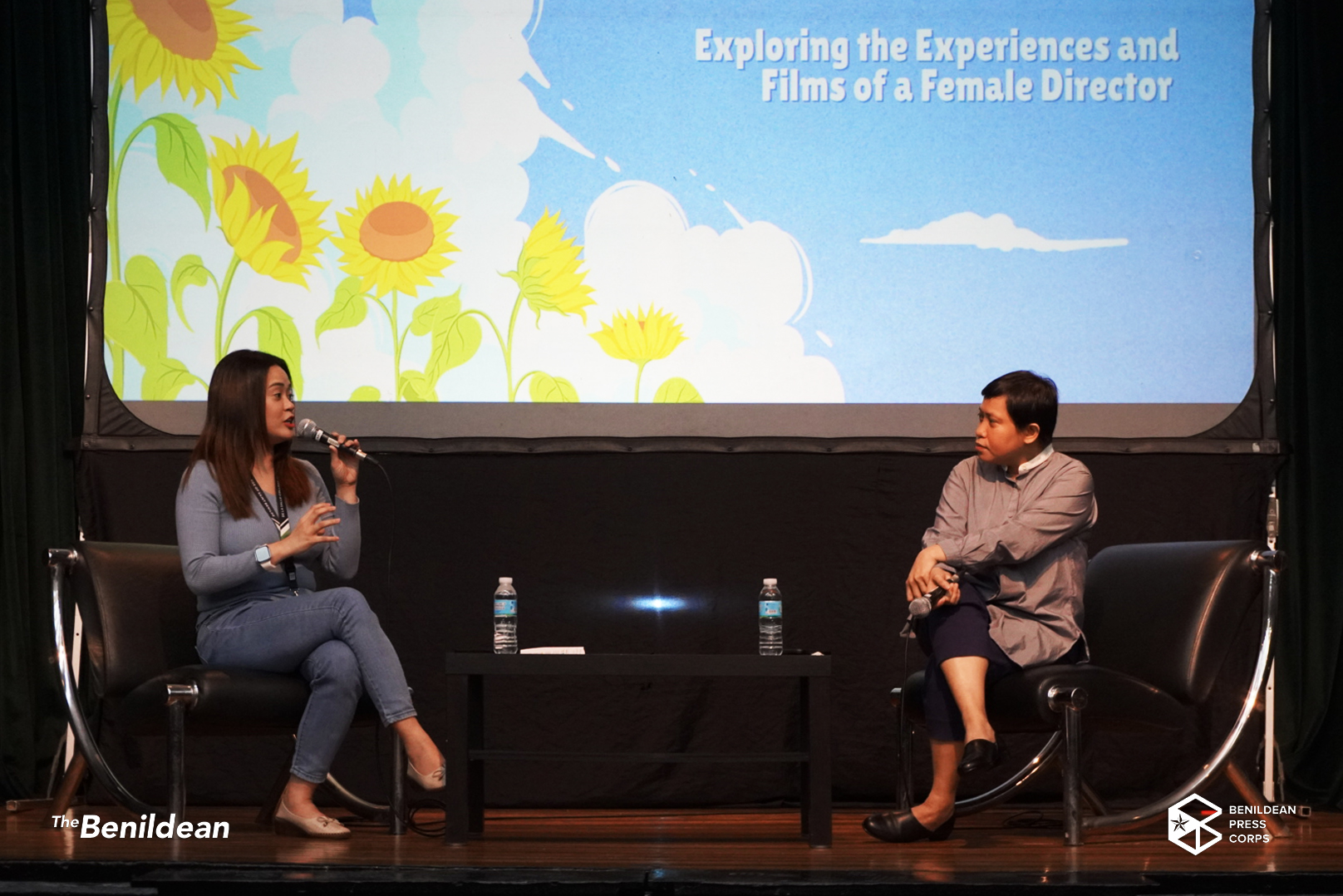




The Women Around Us, organized by Benilde Arts Management (BeAM), provided an avenue for Benildeans to explore Direk Irene Villamor’s creative progress and the view she sees from a camera lens.
Villamor is known for her movies being anti-romantic—a term the director used to describe her own works—such as “Ulan” and “Camp Sawi.” During a Q&A session, these themes were discussed, sparking a conversation. Led by Ms. Nicole Trisha Panganiban, a Consular and Diplomatic Affairs (AB-CDA) alumna and the Institutional Gender and Development (GAD) Focal Person of the College, the forum carried a casual and conversational flow, providing a safe space for everyone in the theater to speak their minds.
Shifting the focus
The event, held on April 7 at the 5/F Augusto-Rosario Gonzalez (ARG) Theater, Taft Campus, was not only a way to get to know the well-known director and promote her new film “Midnight Girls,”—starring Jodi Sta. Maria, Sanya Lopez, Loisa Andalio, and Jane Oineza—but a heartfelt project spearheaded and opened by Nichole Anne B. Bretaña (Bretz), the project head and an ID123 student from the Creative Industries Management (AB-CIM) program.
In an interview with The Benildean, Bretz shared that it was no secret that women dominated the officers’ board of BeAM. ”Being in the creative industries, I've always seen that women were at the forefront of nurturing the arts, creativity, and I really thought that it was time that we give that narrative to them.”
“[...] Art is always political, and art is always about advocacy. It's not just about self-expression,” Bretz conveyed. The Women Around Us tackled Villamor’s upcoming movie “Midnight Girls,” a piece that tackles Filipina sex workers in Japan—a big step to shedding a positive light for misunderstood and underappreciated women. According to Villamor, the movie not only portrayed a sexual innuendo—it is work.
Beating the stigma
The film industry is male-dominated which makes it harder for women to penetrate the scene—was a common misconception in society. However, in an exclusive interview with The Benildean, Villamor clarified that, “In other countries, it's male-dominated, Hollywood especially. But what's different in the Philippines is [that] our producers, our main producers are mostly women.” Tracing back to history, the film industry in the country was pioneered by women such as Armida Siguion-Reyna, one of the first producers, and Malu Santos who headed Star Cinema.
“[...]It was very much a matriarchy in the industry… there are more women who speak up,” Villamor shared. According to her, when entering an industry, “Don't think that you're a woman… [but] as a creative [or individual,] because you already know that you have a lot of boundaries that you're going to break as a woman… just enter as an individual,” an ideal contemporary mindset that should be practiced by society—prioritizing strength and skills, where gender doesn’t matter.
This transparent change was brought to light during the discussion and Christine Embate, an ID123 Film (AB-Film) major and event-goer was pleased to learn about this. “[...] Nakita ko na, nagkakaroon na ng change right now sa industry… pero madami pa rin kami mga kilala na, stuck from that kind of norm,” she shared in an interview with The Benildean. There is still a long way to go but this event proved that change is possible and how it has already started.
Lady Sachiko D. Collo, an ID125 student from the Marketing Management (BSBA-MM) program, expressed her excitement as a fan in an interview with The Benildean, when she found out that Villamor was going to have a forum and promote her new movie in Benilde. But what surprised Collo during the event was Villamor’s genre shift from anti-romantic movies to her upcoming film, “[...] Mabibigyan ng importance kung ano nga ba ‘yung history nung sex work… so na-highlight talaga siya [sa ‘Midnight Girls’],” Collo expressed.
Representing reality
“The passion comes from that energy that I get to tell stories,” was Villamor’s fuel to continue her career as a writer-director—a career that she fortunately loves. She told The Benildean that she does not know how to do anything else, but it is a privilege for her to have a job that provides income and one that she is passionate about.
After 10 years in the film industry, the highlights of her experience were not the awards or recognitions, but an unforgettable encounter during a promotional event for “Vodka, Beers, and Regrets“ a movie about alcoholism.
“[...] Someone approached me and said that he watched ‘Ulan’, and that he has dilemmas with his gender identity, and within himself.” After two years since the release date of “Ulan,” the fan expressed his gratitude and appreciation for the strong support that the film brought.
For Villamor, it’s moments like these that allow her to continue creating stories that affect individuals—whether it may be positive or negative, “[...] As long as people are affected by it, or it initiates conversation, that's what fuels you to make something else again.”
Complex female characters such as Aya (Anne Curtis) from “Sid and Aya: Not A Love Story,” captured the hearts of Filipinos, leading it to box-office success. But for the director, Aya was more than a fictional character she wrote; Aya was a heartfelt representation that she could personally relate to. The type of person who views love as an experience that you have to be prepared for. “That's why she always has boundaries,” Aya is a headstrong woman who possesses inner strength, and is afraid of vulnerability—a reality that women face.
“I feel that people would also relate to that because we try to be strong in front of many people,” Aya’s journey in the film ended with acceptance, “Even in all the hardships and struggles, she will always believe in herself and say that, ‘you did good.’ She's the kind of person who will pat herself on the back even if there's nothing she can do.”
Like Aya, “Midnight Girls,” is a movie that will uncover stories that have been ignored and frowned upon. The film followed the story of Japayukis, who battled with difficult hurdles in a foreign country with only each other and themselves to rely on.
“Midnight Girls” will hit cinemas this coming May 13, 2026.
The Women Around Us was not only a promotional event for Villamor’s upcoming movie, but also an act to not confine the celebration of womanhood to a month—but one that should be done throughout the year—an assurance for all women that change is happening now.
