
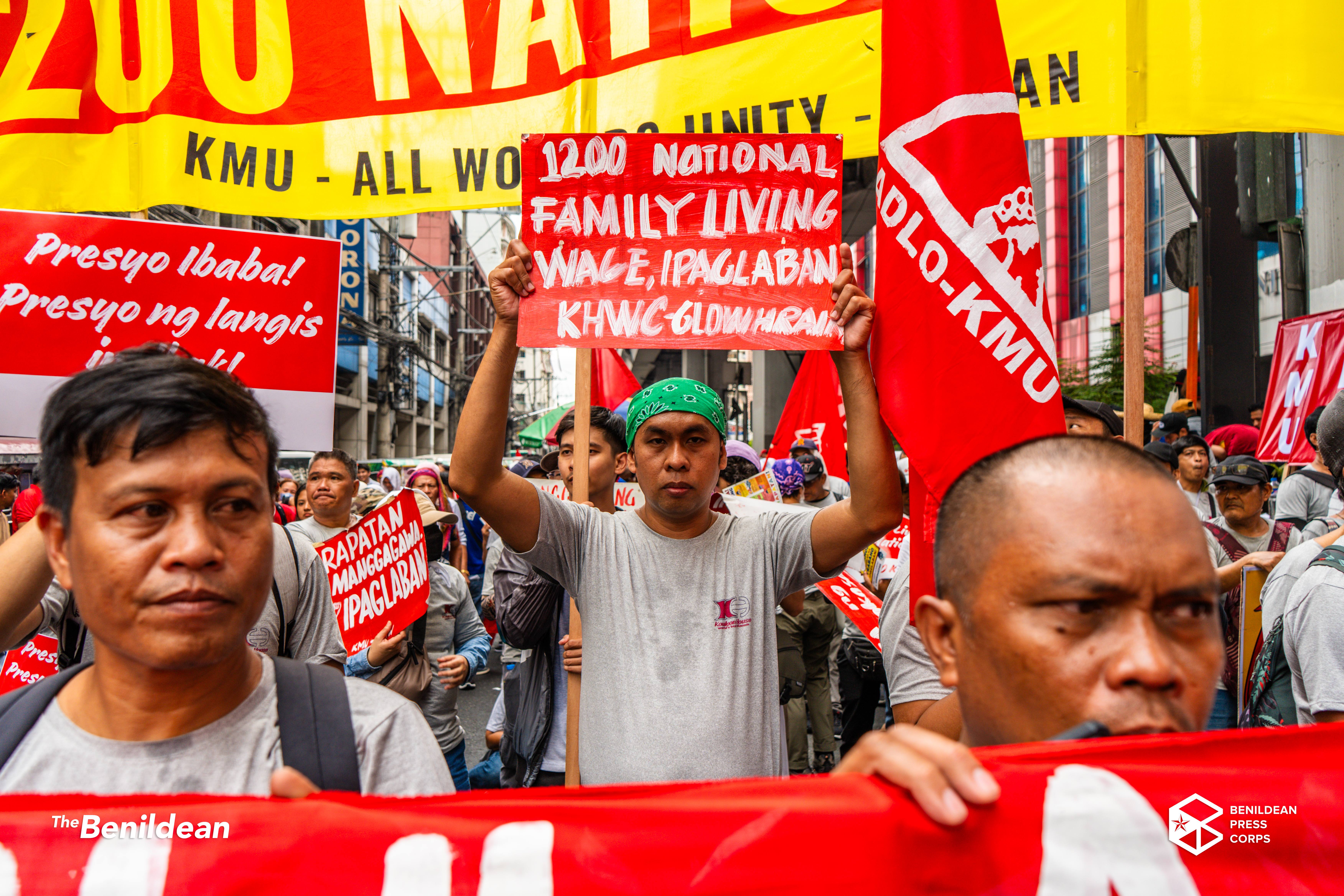




Several economic issues were raised during the mobilization organized by Kilusang Mayo Uno (KMU) on May 1 to call for wage increase, lower prices, accountability, and progressive systemic change to manage the increasing costs.
Following the Israel-Iran war, economic issues have started to resurface in the Philippines. As of June 2025, the Department of Energy (DOE) has been taking measures to ease the fuel increase such as reaching out to oil companies to stagger prices, allocating fuel subsidies from the 2025 budget to support local transportation, and setting aside ₱585 million for farmers and fisherfolk.
Meanwhile on June 25, 2025, President Ferdinand Marcos Jr. downplayed the economic impacts of the Middle East crisis, stating that, “So far, it has no significant effect in the economy.”
However, this was retracted on March 24 as Pres. Marcos signed Executive Order (EO) No. 110, declaring a state of national energy emergency. This EO decreed a committee that will supervise responses to maintain energy supply and safeguard the country from global market disruptions.
Despite the several initiatives, the Philippine economy continues to deplete. During the labor day march to Recto, organizations such as Health Alliance for Democracy demanded the removal of 12% value-added tax (VAT) and excise tax on oil products. On the other hand, most labor unions called for a ₱1,200 minimum living wage to keep in pace with the inflation. As for the nursing sector, Filipino Nurses United demanded to “increase state funding of health to 5% gross domestic product (GDP).”
While most appealed for higher wages and lower prices, others brought attention to other crises, such as justice for the Toboso 19, an end to United States (U.S.) imperialism, and accountability from the Duterte-Marcos administration.
Banners with messages such as, “Marcos-Duterte Panagutin,” “Oil Deregulation Law, Ibasura,” and “Defend Negros,” were raised as they marched, chanting slogans such as “Uring manggagawa, hukbong mapagpalaya,” and many more.
Government mitigation measures amid inflation
Aside from the actions done by the UPLIFT Committee mandated by EO 110, multiple agencies recently issued and proposed various interventions. On April 7, the Department of Agriculture (DA) assured that measures are in place to diminish the effect of inflation. Immediate interventions included the release of financial aid, fuel subsidies, and farm inputs for affected farmers and fishers.
The following day, April 8, the Department of Labor and Employment (DOLE) chaired the National Tripartite Industrial Peace Council (NTIPC) to discuss immediate actions in response to pressing issues affecting both the worker and employer sectors.
The discussion resulted in a decision to prioritize employment preservation and ensure that business continuity measures remain accommodating to workers’ needs amid rising costs.
Raymond Democrito Mendoza, Trade Union Congress of the Philippines (TUCP) Representative, filed House Bill No. 8860, also known as the “Patas na Ambag sa Tax para sa Angat-Sahod” (PATAS) Act on April 14.
It aims to ease the financial burden on Filipino workers amid inflation. The bill primarily seeks to reduce or eliminate income taxes for low- and middle-income earners while increasing taxes on upper income earners to create a more equitable tax system.
On the other hand, Sen. Mark A. Villar filed Senate Bill No. 2032 for the Relief and Recovery Interventions for Low-Income Earners, Minimum Wage Earners, Self-Earning Individuals, and Micro, Small, and Medium Enterprises (MSMEs) Act on April 22.
The bill proposes to provide grace periods for rental and loan payments, penalty-free of modifications, adaptable deadlines, and low interest credit to mitigate the rising costs of goods and services that put vulnerable sectors at risk.
In an interview with The Benildean, a worker using the alias “Emily,” shared her experience amidst the rising prices.
“Talagang mag-eextra ka, mag-eextra income ka, o hindi kaya, titipirin mo ngayon ‘yung bigas mo o ‘yung gasul mo,” she explained, in response to changing budgeting habits amid price increase, especially as a minimum wage earner.
The secretary general of Migrante Philippines, Arlene Castillo, also shared her insights with The Benildean as a former Overseas Filipino Worker (OFW).
“Kaya kami sumama dito para ipanawagan ang $800 na sahod ng mga manggagawa sa ibayong dagat at siyempre ₱1,200 minimum living wage dito sa ating bayan…” she said, explaining the importance of OFWs to the Philippine economy.
She stressed how the ongoing conflicts affect a lot of sectors in our country such as transportation, bills, and food. “Hindi na talaga nakakasapat ang sinasahod ng manggagawa dito sa ating bayan na minimum. Kaya kailangan natin[g] lumahok sa mga ganitong pagtitipon para ipanawagan sa gobyerno na tugunan ang problema ng mamamayan na naghihirap...”
When asked what her message was to her fellow OFWs, she answered, “Itulak natin sa gobyerno na [bigyan] tayo dito ng maayos na trabaho para hindi na tayo lumabas ng sariling bansa natin, hindi na tayo magpapaalipin sa ibayong dagat, may nakakabuhay na sahod para wala nang pamilyang naiiwanan.”
Moreover, Diana Buenaobra shared in an interview with The Benildean her reasons for joining the Labor Day march despite the heat.
“According to the study of IBON Foundation, ₱1,200 ang nakabubuhay na sahod ng pamilya na may 5 miyembro. Napakalayo kung ikukumpara natin sa almost ₱500 [na sahod] dito sa Metro Manila at ₱300, more or less, sa other parts of the country. Hindi ka talaga mabubuhay!” she stated, explaining that she joined the protest as she believes the cause is important for the other organizations present at the march.
She added that while the march may cause inconveniences and disturbances due to road closures and noise, “At the end of the day, ito ay para sa atin lahat.”
The interview ended with her message to the government, “Magbigay ng not band-aid solutions sa mga problemang nakikita natin, kung ‘di talagang solusyonan ‘yung ugat ng problema at magkaroon ng mga polisiya na makatao. Hindi profit-driven. Unahin natin ang welfare ng mga mamamayan, ng taong-bayan.”
As the economic uncertainty persists, the current situation highlights a need for policies that prioritize long-term public welfare over temporary relief.
