
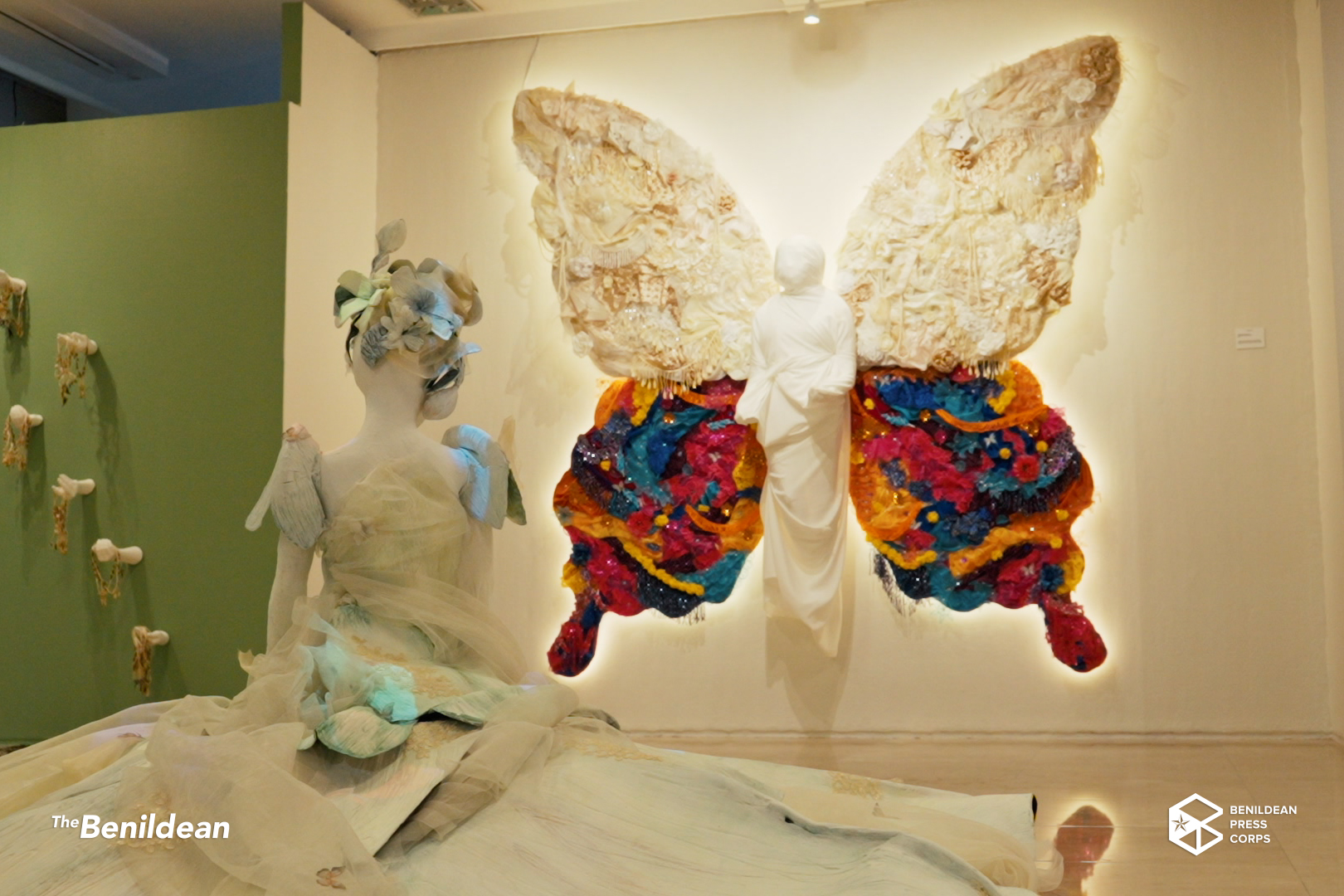




Marking a milestone for emerging artists and culture-based art education, Carmela Marfori of De La Salle-College of Saint Benilde (DLS-CSB) opened her first solo exhibit, titled Malaya Clara, Malaya Ka Ba?, at the National Commission for Culture and the Arts (NCCA) Gallery on May 16. Her solo exhibit showcases works that explore femininity, identity, and freedom through contemporary visual storytelling.
For generations, the image of Maria Clara shaped expectations of femininity in Filipino society, embodying ideals of being gentle, reserved, and modest. Yet beneath this delicate figure lay a deeper question: Was this identity freely chosen, or was it formed within the limits imposed by society?
Art and history have continually revisited the quiet complexities beneath the model Filipina image. Through contemporary visual arts, the exhibit explored what forms of freedom remain unseen in the lives of Filipino women today.
An artist’s mark of excellence
Through textiles and sculptures, Marfori, an ID123 pioneer student of the Fine Arts in Culture-Based Arts (BFA-CBA) program, presented her first solo exhibition. Through installations centered on transformation, the body of work explores femininity and identity as experiences continuously unfolding, suggesting that women are not merely changing but constantly becoming.
In an interview with The Benildean, Marfori shared that her exhibit is deeply personal, almost like a story of her own journey. She explained that when she entered college as a Fine Arts student, she realized something powerful: Art could be a language. Through visuals, crafts, and textiles, she discovered a way to express thoughts and emotions that are sometimes difficult to say in words, while still making them understandable and relatable to an audience.
When asked what she wants the audience to take away from the exhibit, she emphasizes self-relection. “[...] ano nga ba talaga ang basehan ng pagiging malaya o hanggang dito na lang ba tayo magiging malaya?” For the artist, true freedom begins within the self; it comes from recognizing our choices as these shape our own sense of freedom. She hopes viewers see that freedom is not just something given by society, but something defined from within.
Unfolding the creation
Inside the NCCA Gallery, the artist reception opened with a welcome remark from Maria Teresa Rayos Del Sol, head of the NCCA’s National Committee on Art Galleries. She emphasized that “[...] ang gallery ay hindi lamang sisidlan ng mga obra, kundi tahanan ng diskurso, pagninilay, at pagbabago,” framing the space that welcomes dialogue, reflection, and transformation rather than mere display.
The program shortly introduced a dance performance from the Benilde Experimental Dance. This was followed by a message from curator Wilfredo Offermari Jr., a professor of the artist during her first year in Benilde. Offermari shared that his favorite part of the exhibit was the concept of Sa Pagitan, which draws from the word sampaguita. He explained that the work reflects the young artist’s family values and faith in God as grounding forces that unfolds possibilities.
Before the official opening of the exhibit, the artist delivered a message in which she reflected on the central idea of her work. She shared, “Ang taong magpapalaya sayo ay ang taong kaharap mo pag nakaharap [ka na] sa salamin,” a line that encapsulates the exhibit’s exploration of selfhood and liberation.
A gallery of freedom
The exhibit by the young artist is composed of a series of installations that examine identity not as something fixed, but as something constantly formed in the act of self-recognition and becoming.
Inside the gallery, Marfori’s works are divided into five sections. On the right side, she lays bare the origin of her practice, where bold ideas sketched in fragments are displayed, shaped through small crafts, and handwritten notes, allowing the audience to witness where her artistic journey first took form.
Following this, her first work is presented under the Milagrosa series, a personal exploration of femininity. In Milagrosa: A Feminine Awakening-Si Mila Version 1 and 2, Marfori shared that the piece began during her first-year painting class, where her professor encouraged her to explore beyond traditional paint and work with mediums she felt comfortable with. This led her to textile art and eventually to Ang Hardin, a contemporary textile-based collection featuring pieces such as Pagbabalik, Paglayo, Pagpapahinga, Pagtatagpo, Pagkakaugat, at Pagbitaw.
She later created the Malaya Clara, composed of fabric, jewelry wire, beads, and plaster. Beginning with a smaller version centered on becoming and inner freedom, she later expanded the work into a larger piece in which the figure appeared fully realized.
The exhibit also includes interactive installations such as Sumpa Kita, where sculpted hands along the walls invite audiences to offer sampaguita, and Malaya Ka Ba?, a mirror-based artwork that asks viewers to pause and reflect on their own sense of freedom. In between these works is Sa Pagitan, which symbolized the often-overlooked stage of womanhood, capturing the quiet space between becoming and fully understanding oneself.
In an exclusive interview with The Benildean, BFA-CBA program chair Ms. Helena Sharon Malinis shared that the program takes great pride in supporting the artist throughout the entire process. She added that other programs were also invited to participate, including student performers, allowing the wider school community to come together in support for Marfori.
Ultimately, the exhibit reexamines Maria Clara not as a fixed symbol of ideal femininity, but as a reflection of the evolving realities of Filipino women.
The exhibit will remain at the NCCA Building ground floor until May 31.
