
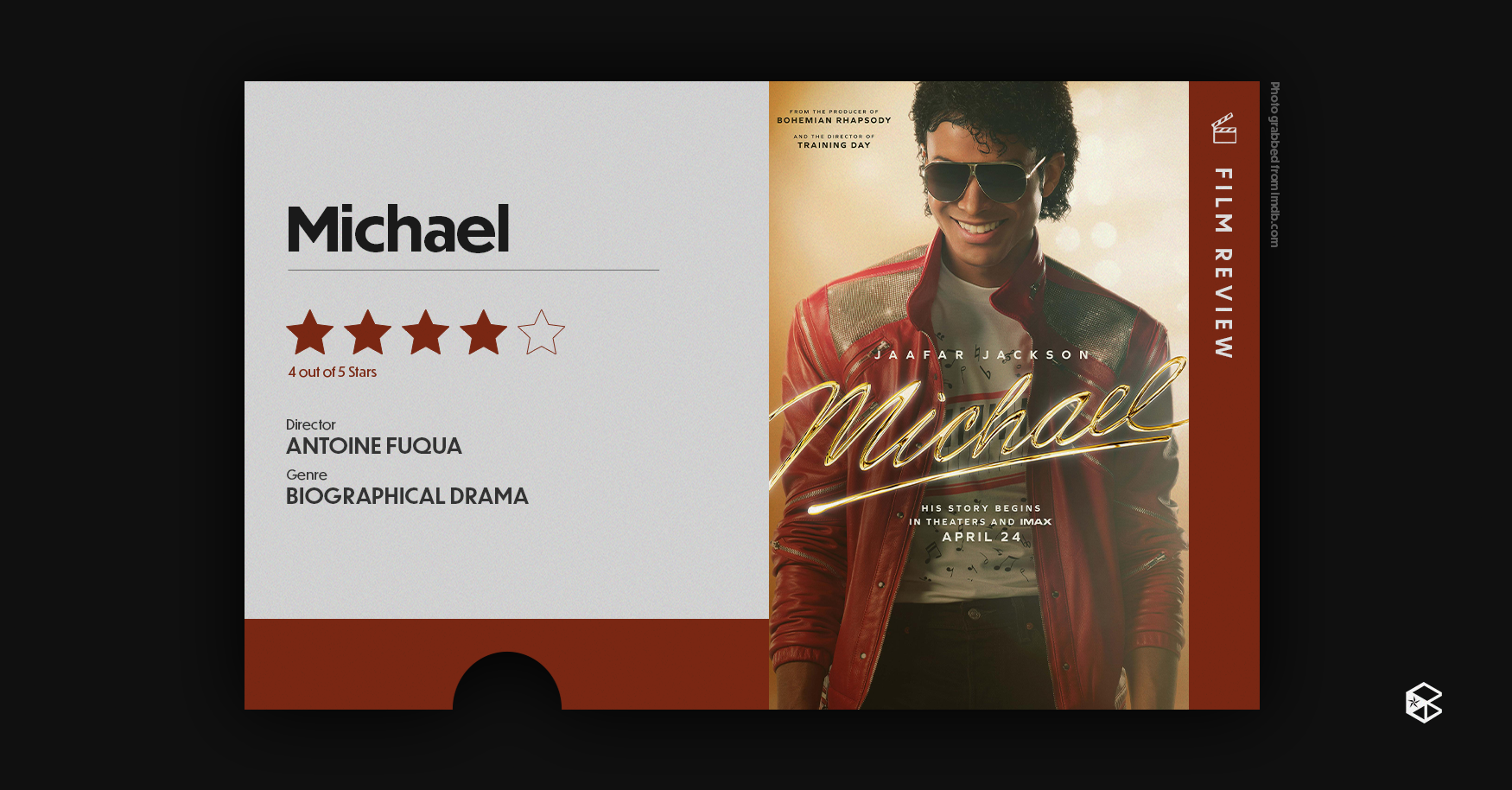




Distributed by Lionsgate and Universal Pictures, MICHAEL was released in Philippine cinemas on April 22, directed by Antoine Fuqua and produced by Graham King, who is known for his work behind “Bohemian Rhapsody.” For two hours and ten minutes, the world revisits the iconic performances of Michael Jackson from a different perspective, one that explores human nature.
The movie starts in 1966 when the Jackson 5 (later The Jacksons) trained in their living room with a pair of piercing eyes watching their every step. Joseph “Joe” Jackson (Colman Domingo)—their father—envisioned the perfect group that would bring them out of the slumps with 8-year-old Michael (Juliano Krue Valdi) at the center of the success. According to Joe, “you’re either a winner or you’re a loser,” and from 1979 to 1988 the film follows Michael (Jaafar Jackson) as he goes off the wall to win against the control of his father and lead his life the way he’d always wanted.
Black or white
The inaccuracies of the biopic were no secret. MICHAEL only introduced six of the Jackson siblings, failing to mention the rest, especially Janet Jackson—arguably the other relevant Jackson besides the king of pop. Janet politely declined participation in the film, creating a huge plot hole that could not be covered. But what netizens were upset about was the absence of the alleged inspiration behind the song “Dirty Diana.” Diana Ross’ actress was cut out of the project due to legal considerations—with her scenes already filmed, major re-editing had to be done, resulting in inconsistent pacing seen throughout the film.
It was hard to stay hooked at the start of the biographical drama, with Michael’s childhood arc looking more like a music video than a cohesive film narrative. The movie failed to portray the hardships and the pressure Joe placed on the shoulders of his children. Yes, the scenes showed the cruel actions done towards the siblings but the extremely fast pacing left the audience unable to understand the grave pain that these children endured, especially Michael during the early days of their career.
Important details such as Michael’s chronic skin condition, vitiligo, were mentioned in a belittling manner, with no further explanation on when it started or how bad it was at the time. His first-ever rhinoplasty was told differently, far from what had actually happened. Due to an accident during his dance practice, he underwent the procedure to fix it, but the film portrayed it as Michael’s desire to resemble his favorite cartoon character, Peter Pan. The film reframed the decision as stemming from insecurity—an issue that haunted him throughout his life, but not in this instance.
Who’s loving you
Joe Jackson has always shown value in his family—the Jackson branding to be more specific. This theme is carried out throughout the movie where the word “family” was always thrown around, yet hardly ever seen. MICHAEL was not a movie that showed the world how he got famous. Rather, it was a story of Michael battling with his father for autonomy, and this is where the biopic shines best in its portrayal.
Throughout the movie, whenever Colman Domingo is on screen, you can’t help but feel anxious together with Michael. The actor does an eerily great job of evoking unresolved daddy issues in the audience—you won’t even realize you were holding your breath until Michael starts performing on stage. Colman’s character was obviously portrayed as the villain of the film, one that showed no development or empathy for his family which contradicts with his values.
Joe Jackson was less of a father and more of a manager. The film did not hold back when it came to showcasing this, as seen in the multiple instances that depicted the morally detached nature of Joe: in the successful life he was living, the people he used as a stepping stone were merely tools.
With family being Michael’s sole reason for continuing as a member of The Jacksons, the biopic showed no scenes of his siblings supporting him besides Katherine Jackson (Nia Long), their mother. But perhaps this was not a misstep from the writers, because maybe, throughout Michael’s abusive experiences, his definition of family has become distorted. The film does not only showcase the luminous star’s battle with his father, but the grave loneliness he felt despite being surrounded by “family.”
Heal the world
Jaafar Jackson was the star of the show, compensating for what the film lacked. With no prior experience in acting and only two years of training, he portrayed his uncle in the best way possible—even going as far as looking exactly like Michael. Despite the biopic’s inaccuracies, Jaafar exceeded everyone’s expectations and revived not only the nostalgic memories of Michael but his goals of changing the world.
The film painted a clear picture: Michael Jackson was a dreamer. Outside of music, he spent his time on treating animals like his friends, and whenever he needed to escape, he turned to re-reading the stories of Peter Pan in Neverland. Michael was different, and that difference shaped how others treated him—for better or worse—deeply affecting his social interactions.
Many viewers consider MICHAEL a sugarcoated portrayal of his life, but the movie did not fail in showing his pure love for children. Even during his lowest moments, the movie showed scenes where he would visit hospitalized kids, giving them gifts, helping them pass time through substantial conversations, and donating his earnings to hospitals.
“Spread love, joy, and peace… that is what I want the world to feel,” were the words he said in the film. MICHAEL pays homage to his greatness that surpasses death and transcends throughout decades—even topping the charts of the Global Digital Artist Ranking. Multiple netizens have mentioned feeling a surge of inspiration leaving the cinemas, older generations reliving their youth, and even old videos of Michael resurfacing across the internet.
Perhaps 16 years was too soon to re-open painful memories and grief for his inner circle, or maybe the world isn’t ready to face Michael’s even darker moments. MICHAEL may not be the most accurate portrayal of the King of Pop’s early days—much like other existing biopics—but it sure did continue his goal: to create change. Today, at a time when disaster is happening in multiple parts of the world, Michael came back to raise morale and inspire everyone that they can also beat and conquer their own Joe.
Watch MICHAEL in all cinemas now.
