
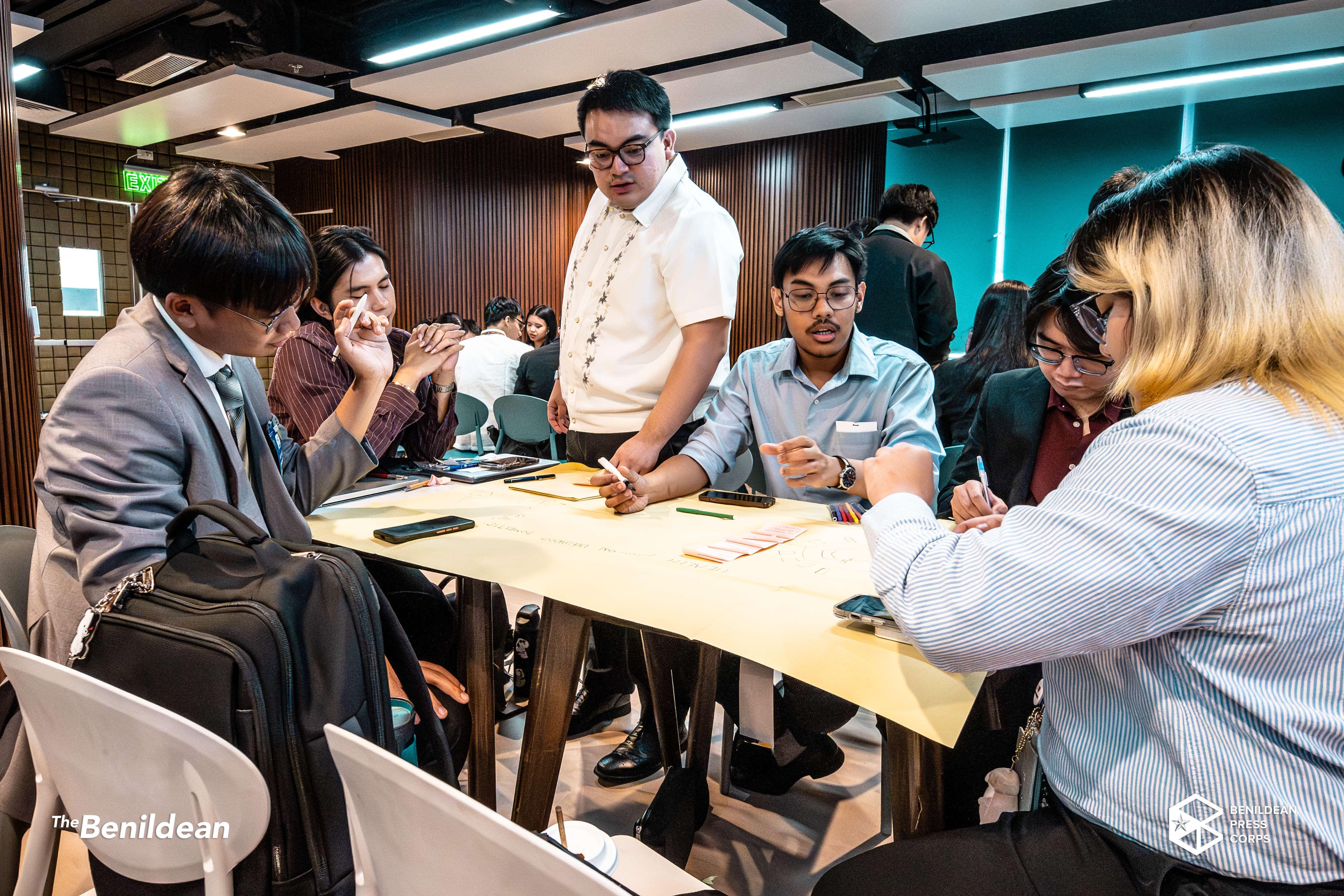




The Philippines’ first Italy-International Renewable Energy Agency (IRENA) Action for Climate Toolkit (I ACT) Workshop was held on May 23 at 2/F Ideation Hall, Atrium Campus. Spearheaded by the Youth for Energy-Southeast Asia (Y4E-SEA), Benilde School of Diplomacy and Governance (SDG), and the Italian Embassy in Manila, the event aimed to train youth leaders on mobilizing climate and energy initiatives, policies, and issues in the Philippines and globally.
The I ACT Workshop was established by the Italian Ministry of Foreign Affairs and IRENA, supported by the SDG7 Youth Constituency and United Nations Children’s Fund (UNICEF) as knowledge partners in developing the program, to foster climate literacy and awareness on renewable energy transition with peer-led and non-traditional education, benefitting more than 6,000 people from over 40 countries. The event also encouraged delegates to independently form a local I ACT Peer Educator Network Group to carry out their climate and energy related projects and organize the next I ACT workshop for their local communities.
The program commenced with four opening remarks from IRENA Director-General Francisco La Camara, Y4E-SEA Co-Founder and Managing Director Amira Bilqis, Benilde SDG Dean Gary Ador Dionisio, and Italian Ambassador to the Philippines H.E. Davide Giglio to formally welcome delegates and guests.
Throughout the speeches, Mr. La Camara and Ms. Bilqis highlighted I ACT’s “training of trainers approach,” emphasizing that learning continues in future workshops and projects and does not end at the event. Meanwhile, Mr. Dionisio and H.E. Giglio imparted their insights on environmental diplomacy, stressing urgent collective and innovative action amidst the complexities and indifference to the climate crisis.
Heads from local government agencies, Department of Energy (DOE) Chief Science Research Specialist Ms. Liza Pangilinan, Energy Regulatory Commission (ERC) Director III of the Market Operations Service Ms. Sharon Ocampo-Montañer, and Department of Environment and Natural Resources (DENR) Assistant Secretary for Policy, Planning, International Affairs, and Climate Dr. Noralene Uy, delivered keynote speeches to brief delegates on the climate and energy landscape, issues, and policies to assess the Philippines’ progress in mitigating climate impacts and evaluating energy usage.
“Introduction to I ACT 101” was given as an overview to the event expectations, module topics and objectives, and house rules.
Ms. Bernadette Anne Buensuceso, Country Director for the Philippines of Y4E-SEA, taught Module 1 on dispelling climate and energy myths and Module 6 on youth engagement. Ms. Lara Jean Salaysay, Founder of Green Economy Ready, covered Module 2 on renewable energy sources and Module 5 on just and inclusive energy transitions. Mr. Stvenson George Tupas, Trustee and Assistant Treasurer of the Alumni Association of Asian Institute of Management (AAAIM) and Central Banker, discussed Modules 3 and 4 on policy and infrastructure frameworks and their connection to SDGs respectively.
In between modules, two spotlight sessions were also presented by WeGeneration Initiative Executive Director and social worker Ms. Christianne Santos and DENR Officer-in-Charge Chief of the Strategic Alliance and Environmental Partnerships Division Ms. Ann Hazel Javier.
Ms. Santos shared a case study of one of WeGeneration Initiative’s projects with the United Nations Development Programme on solar panel installation. Meanwhile, Ms. Javier introduced DENR’s Youth Desk established in 2023 which provides training through modules focusing on youth resilience building for climate action and disaster response, and capacity building programs in different provinces.
To conclude the lectures, delegates declared their commitment to climate and energy initiatives by pledging to be a peer educator and changemaker contributing to a world of innovation and sustainability.
The event concluded with a short awarding ceremony, recognizing winners with informal awards and partner organizations with certificates of appreciation.
In an interview with The Benildean, Ms. Buensuceso and Ms. Santos shared their advocacies on how transitioning to clean renewable energy sources can alleviate climate effects that ultimately improves communities long-term, with participation in I ACT and other environmental initiatives being part of it.
Ms. Buensuceso said that climate and energy matters are not limited to people with technical skills who work in these fields, but involve a wide range of stakeholders. Through the I ACT program, they “provide [a better] […] understanding about what the climate and energy nexus entails with the support from our partners, and as well as from the [selected Filipino] peer educators.”
The program also integrated IRENA’s standardized framework and perspectives from the Philippine government partners “to build [an] overview [and] foundational knowledge” while making it fully relevant to the local context.
Ms. Santos also echoed the same sentiments with Ms. Buensuceso, emphasizing that energy brings feasibility into daily lives, from agriculture, health, infrastructure to the entire economy. Resolving climate change and traditional energy usage is a priority for the Philippines as “different researches [cite the country as the] number one to number three most affected by climate change,” experiencing stronger typhoons, flooding, droughts, and extreme heat that is exacerbated by the use of coal and oil.
To streamline the country’s transition to renewable energy, Ms. Santos suggested adopting solar energy for homes and establishments because of its convenient installation and sunlight exposure while “the government and private sector should invest in renewable energy infrastructures, together with battery storage systems, smart grids, and energy-efficient programs.”
She also encouraged the public, particularly students, “to be aware of the realities that they are in and to be grateful for what we have [so that] we take care of it.”
To continue WeGeneration’s mission, Ms. Santos expressed that the organization is open to collaborate with other schools and other organizations willing to learn more about the climate crisis.
ID124 student participants Andre Martinez and Eurice Coyoca from the Diplomacy and International Affairs (AB-DIA) program shared their experience in an interview with The Benildean, recounting their reflections and motives in participating.
From the interconnected implications and realities of climate and energy matters, Martinez defines “a just and inclusive energy transition” by the collective efforts to improve the environment “even [if] some countries don't believe climate change [and its factors are real].”
Meanwhile, Coyoca’s takeaway is that “a just and inclusive [energy] transition comes with great responsibility […] we really have to strike a balance between development and conservation,” and Martinez asserted that although speaking up and being informed may be a head start for advocacies, it is through intentional actions that actualize them.
Youth involvement on social and environmental issues through initiatives like I ACT Workshop proves that impactful change for the future does not rely solely on waiting for authorities and decisions by experts and policymakers alone, as awareness shifts into active participation.
