
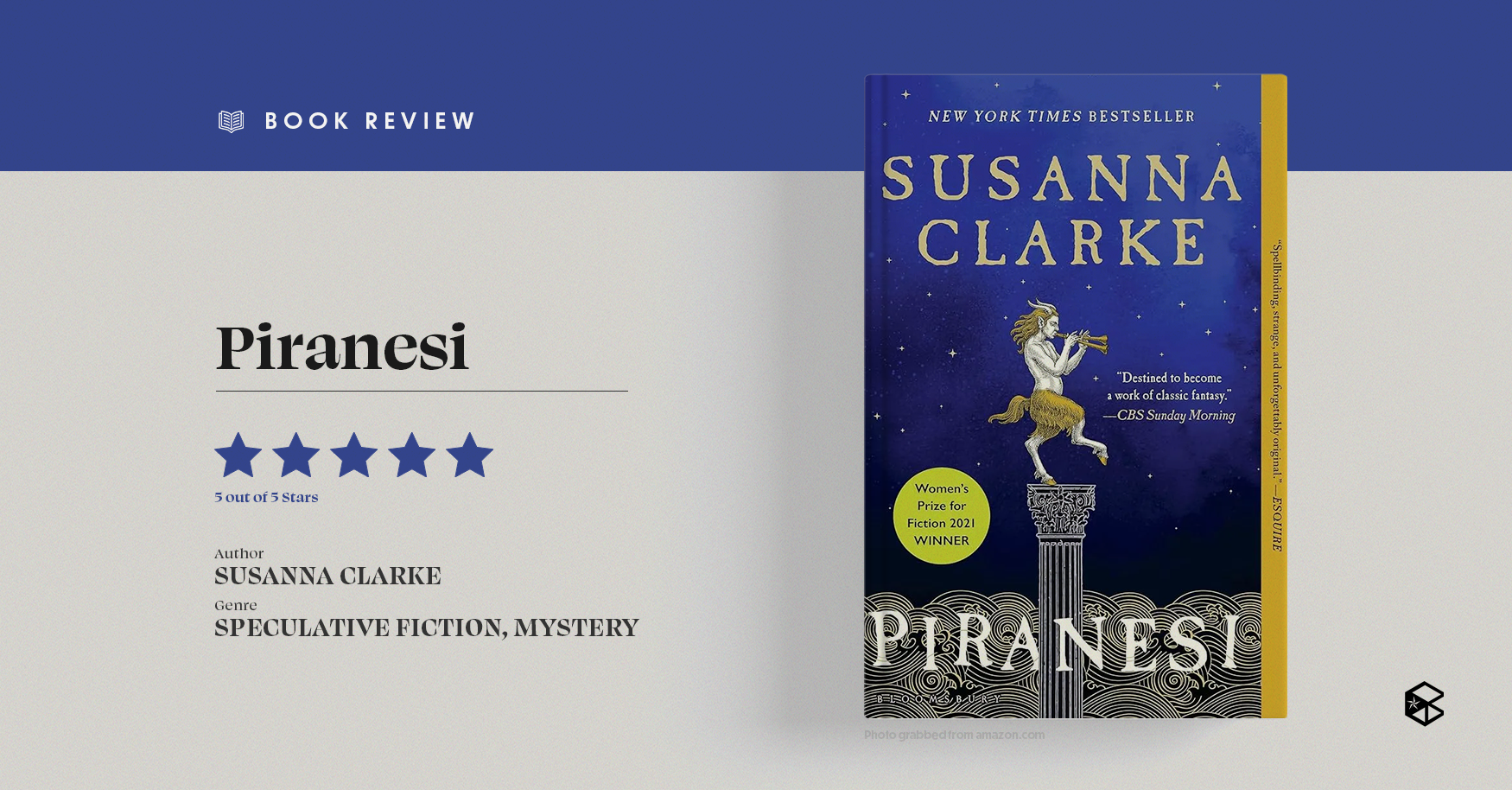




Title: Piranesi
Author: Susanna Clarke
Genre: Speculative Fiction, Mystery
Rating: 5/5
Susanna Clarke’s Piranesi follows a scientist who inhabits the House and explores its seemingly infinite structure of immense marble halls partly engulfed by an indoor ocean and populated by thousands upon thousands of marble statues.
The scientist, known as Piranesi, regularly wanders through the House and documents his findings, wanting no more than to study and immerse in the beauty and surreality of his home, all while attempting to survive by scavenging for food, gathering materials for tools, and managing his shelter. Besides him, only one other living person wanders the halls: The Other, an older yet sophisticated man obsessed with finding the Great and Secret Knowledge. Piranesi considers him a close friend and fellow scientist despite his mysterious and occasionally rude nature.
Together, the two live harmoniously, meeting only on Tuesdays and Fridays to share new research. But as Piranesi continues to explore the House, he discovers evidence that does not belong, recurring fragments of memory from a familiar yet forgotten place and time, and realizes that he and The Other may not be the only living souls walking these halls.
The House is haunted by an unknown past, and Piranesi is right at its center.
The House
The House is the novel's central setting—a massive, beautiful stone structure. As described by Piranesi, the House is divided into three layers: the Upper Halls, which contain the sky and clouds, providing fresh drinking water from rain; the Middle Halls, where Piranesi resides alongside the birds and statues; and the Lower Halls, where the ocean lies and where he fishes for food and other resources. Occasionally, water from the Lower Halls enters the Middle Halls, violently flooding and crashing against its high walls.
The statues are arguably the most interesting part of the House, with thousands of unique statues. Piranesi notes a few as his favorites, including the Statue of the Faun, with its fingers touching its lips and giving him a sense of comfort and protection; the Statue of the Gorilla, symbolizing strength, peace, and endurance; and the Statue of an Angel Caught in a Rose Bush, innocence trapped in a beautiful prison. Deviating from the pristine uniformity of the main corridors, certain areas of the House look less elegant and more rugged and atmospheric. These include the Derelict Halls, where the floors and ceilings have collapsed, and the Flooded Halls, which are entirely submerged in the ocean water.
Piranesi
Piranesi takes center stage as one of the most endearing characters in the short novel. He is an intelligent, meticulous, resolute, and resourceful scientist who is deeply reverent toward the House, revealing a captivating childlike curiosity and wonder. He is also a friendly and respectful man, thinking highly of his companion, the Other, and always eager to help him with his research. However, Piranesi can be quite gullible, overly forgiving, and uncertain of himself. In one instance, the Other demands that Piranesi travel toward a distant hall to retrieve data for him, brushing off his concerns about the dangerous journey. Yet, Piranesi willingly complies, deciding to rationalize the Other’s request as the eccentricities of a brilliant but stressed mind.
Piranesi’s love for the House exceeds simple documentation and appreciation, bordering on a deeply spiritual bond with its distinct fauna, the thousands of statues, the sweeping waters of its Lower Halls, and the bony remains of long-dead humans. Endearingly, Piranesi regularly visits these skeletons, which he has bundled up using fish leather and dried seaweed, and has given each an affectionate name. Unlike the Other, who is generally disinterested in the House itself, Piranesi devotes a great amount of time and attention to studying and marveling at his home, exploring it not only in the name of science, but in devotion and cherishing of the House.
But what we know of Piranesi is only part of his character, with the other half shrouded in mystery.
Cracks in the stone
Piranesi is not the scientist’s real name. It was a moniker given to him by the Other. In fact, Piranesi himself does not know his own name, nor his past, nor how he arrived at the House. The few shreds of evidence he has lie in his oldest journals and in increasingly frequent encounters with anomalies. Throughout the novel, readers gradually unravel the secrets hidden within these stone corridors, the true identities of our characters, and the unknown, yet lingering past that seems to haunt the House and its inhabitants.
Far more than a simple mystery novel, the short novel delves into the magnificence of the House, the complex characterizations of Piranesi and the Other, the slow reveal of truth, and the meaning of home itself. As Piranesi himself would put it, “the Beauty of the House is immeasurable, and its Kindness is infinite.”
