
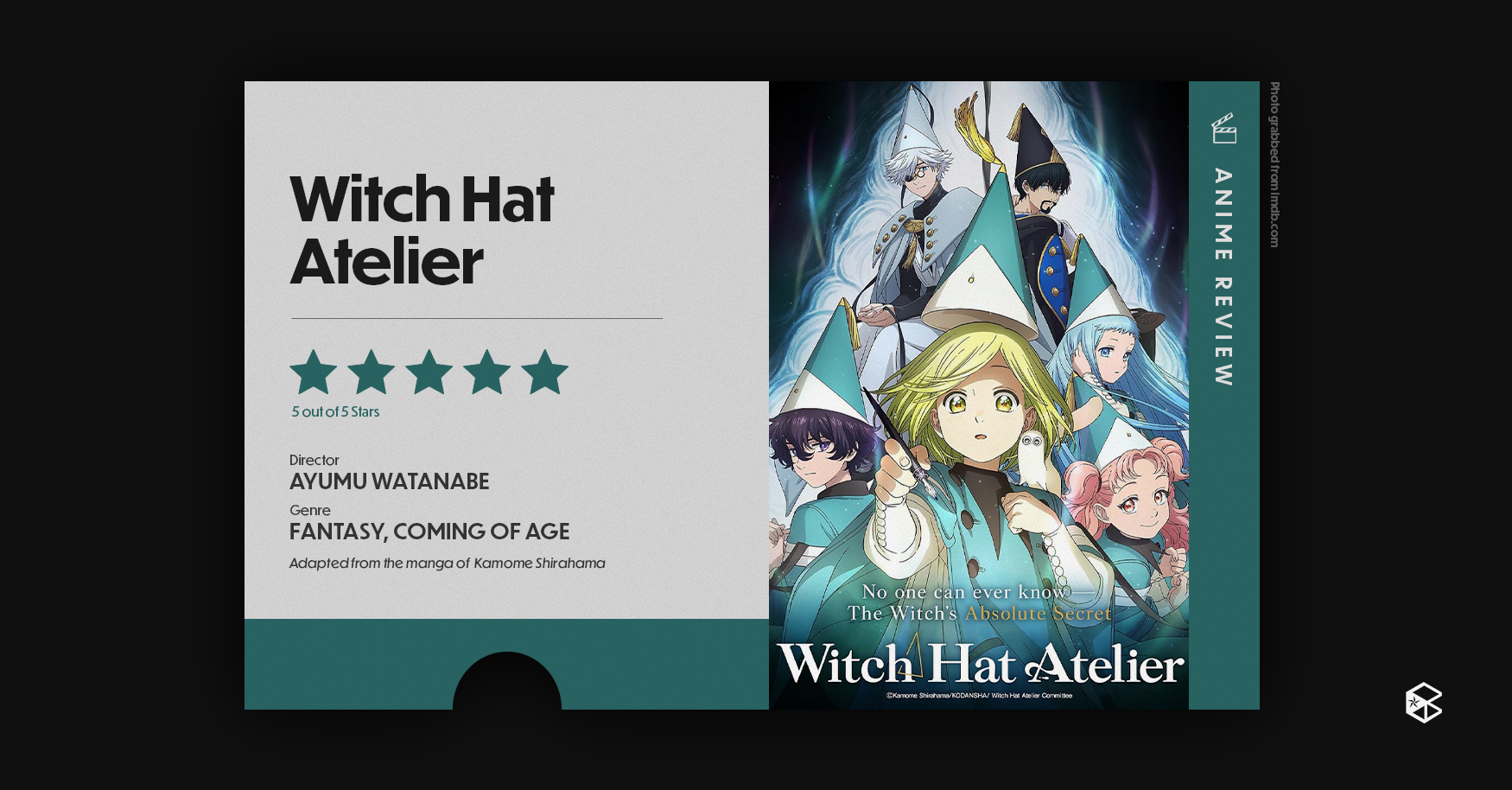




Witch Hat Atelier (2026) sketches different shades of belonging and resistance into a magical world that feels like a living illustration. Directed by Ayumu Watanabe (Summer Time Rendering, Komi Can't Communicate) and produced by Bug Films, the long-awaited anime adaptation of Kamome Shirahama's award-winning manga arrived after a year-long delay.
Running from April 26 to June 22, the series follows Coco (voiced by Rena Motomura), an ordinary girl born outside the world of magic who has spent her whole life watching it from a distance. In this world, magic is said to be bestowed at birth—something you either inherently possess or never will. But when a terrible accident forces her into the hidden atelier of the witch Qifrey (voiced by Natsuki Hanae), Coco discovers the truth that magic can be learned. This truth has been buried deliberately—and Coco's very existence threatens to unravel this system built on centuries of careful concealment and unfairness.
The anime took seven years to produce before finally arriving on screen, with Director Watanabe himself calling adapting Shirahama’s work “a very reckless undertaking,” given how much detail lives in every panel. Yet the gamble pays off. The act of creating art by hand is central to both the anime and the manga, and the adaptation reflects that philosophy through its handcrafted visual style. Every frame feels deliberately composed with the anime embracing restraint—inviting viewers to linger on every scene.
The ink that divides
Most stories fall into the pitfalls of categorizing good and evil to make it easily digestible for the viewers. Witch Hat Atelier, however, draws its own path, creating a world defined by secrecy and power rather than the easy binary of morality. The Pointed Hats—the witches whom Coco joins in—are not presented as purely benevolent, nor are the Brimmed Caps—the group of rogue witches—portrayed as evil for evil’s sake. Instead, the series asks what happens when those in power decide that knowledge belongs only to the select few.
The world runs on a lie told with good intentions. Long ago, magic was accessible to everyone, until it led to catastrophe, wars, and the total collapse of civilization. Eventually, a powerful group of witches came to an agreement, casting a worldwide memory wipe that stripped humanity's knowledge of magic entirely and kept it locked within their own circle. Known as the “Day of the Pact,” this made the Pointed Hat witches the sole custodians of a world-altering secret. The public then grew up believing magic was a birthright, but in reality the memory of how it works was literally taken from them.
While the purpose remains noble, the system that the Pointed Hats created is far from just. They are legitimizing the secrecy as a necessary safeguard against catastrophe. However, their “protection” effectively creates a monopoly on the fundamental laws of everyone’s reality. The people they claim to serve are denied the tools that could meaningfully improve their lives, with their memory wiped if they get too close to the truth.
On the other side stand the Brimmed Caps, the story's rebel faction. They use forbidden magic which rejects the Pointed Hats' laws, and positions themselves as liberators returning power to the people. They actively try to return magic to ordinary people by any means necessary—and "any means necessary" carries a heavy weight in a world where unregulated magic once caused mass destruction.
Apprentices of an imperfect world
In a genre filled with protagonists destined for greatness, Coco’s ordinariness is precisely what makes her extraordinary. She succeeds because she approaches every lesson with curiosity and relentless determination. Coco reflects those who have ever been told that their dreams are impossible. Her tenacity rejects the myth that talent alone defines a person’s potential—proving that the grit to keep learning is just as transformative as innate ability.
That philosophy extends beyond Coco herself. Qifrey is a patient mentor who believes teaching is an act of responsibility, rather than an act of authority, with his atelier becoming a soft space where growth itself is magical. Even Coco's fellow apprentices—Agott (voiced by Hibiku Yamamura), Tetia (voiced by Kurumi Haruki), and Richeh (voiced by Hika Tsukishiro)—initially appeared as carefree children before gradually revealing mature insecurities and vulnerabilities that make their relationships feel remarkably genuine. Instead of competing to become the strongest witch, they grow by learning from one another.
Empathy gives Witch Hat Atelier its emotional weight. Every character, regardless of where they stand in the conflict between the Pointed Hats and the Brimmed Caps, acts from deeply human motivations of fear, hope, grief, curiosity, or the desire to protect others. The series refuses to flatten its cast into heroes and villains. It understands that people are often shaped by the world they inherit as much as the choices they make.
Change at the edges
Strip away the magic and what is left is a story about growing up inside a broken society and having to figure out what to do when you're not powerful enough to fix it. Most stories that introduce a similar systemic injustice either make it so corrupt it feels impossible to fix, or hand the protagonist enough power to dismantle it by the finale. But this anime does neither. The system portrays the devastating limbo of being well-intentioned while still being crushed. And the protagonist, Coco, cannot simply overthrow it—she is twelve, still learning how to draw a circle.
Witch Hat Atelier suggests that people have the power to change things, perhaps not the entire world, but the lives of those immediately around you. And by doing so, you may impact those around you more than you realize. Even the smallest act of defiance can accumulate into something larger, quietly pushing against the edges of a system that once felt immovable, until change becomes an unfolding reality.
Perhaps no character embodies this philosophy more quietly than Tartah (voiced by Mutsumi Tamura), a young magic-tool maker who lives closest to magic while remaining shut out from it. He suffers from Silverwash Syndrome, a congenital condition that strips his vision to shades of silver and gray. Despite his deep knowledge, the Pointed Hats' system was never built with him in mind because potion hues are indistinguishable to his eyes—the world had long decided that he cannot be a witch. But Coco, who herself was told she had no place in magic, refuses to accept that verdict on his behalf. Inspired by her, Tartah picked up his pen to carve a path the system never thought to make.
In an age where AI can generate a painting, write a song, solve an equation, or compose a score—where the act of making something by hand is no longer necessary in the way it once was—comes a story where magic is literally the art of drawing, and where the quality of a spell depends on the patience and care put into each line. Witch Hat Atelier is a love letter to the act of making things with your soul, not just through painting, writing, coding, composing, building. Any creation that makes you unmistakably, you.
Witch Hat Atelier nudges us to believe that the smallest acts of courage have a way of adding up, and that the life you build with your own two hands is worth every imperfect, patient line it takes to get there.
Take a walk with your brush buddy at the Dadah Range with Witch Hat Atelier, available for streaming on Netflix and Crunchyroll!
