
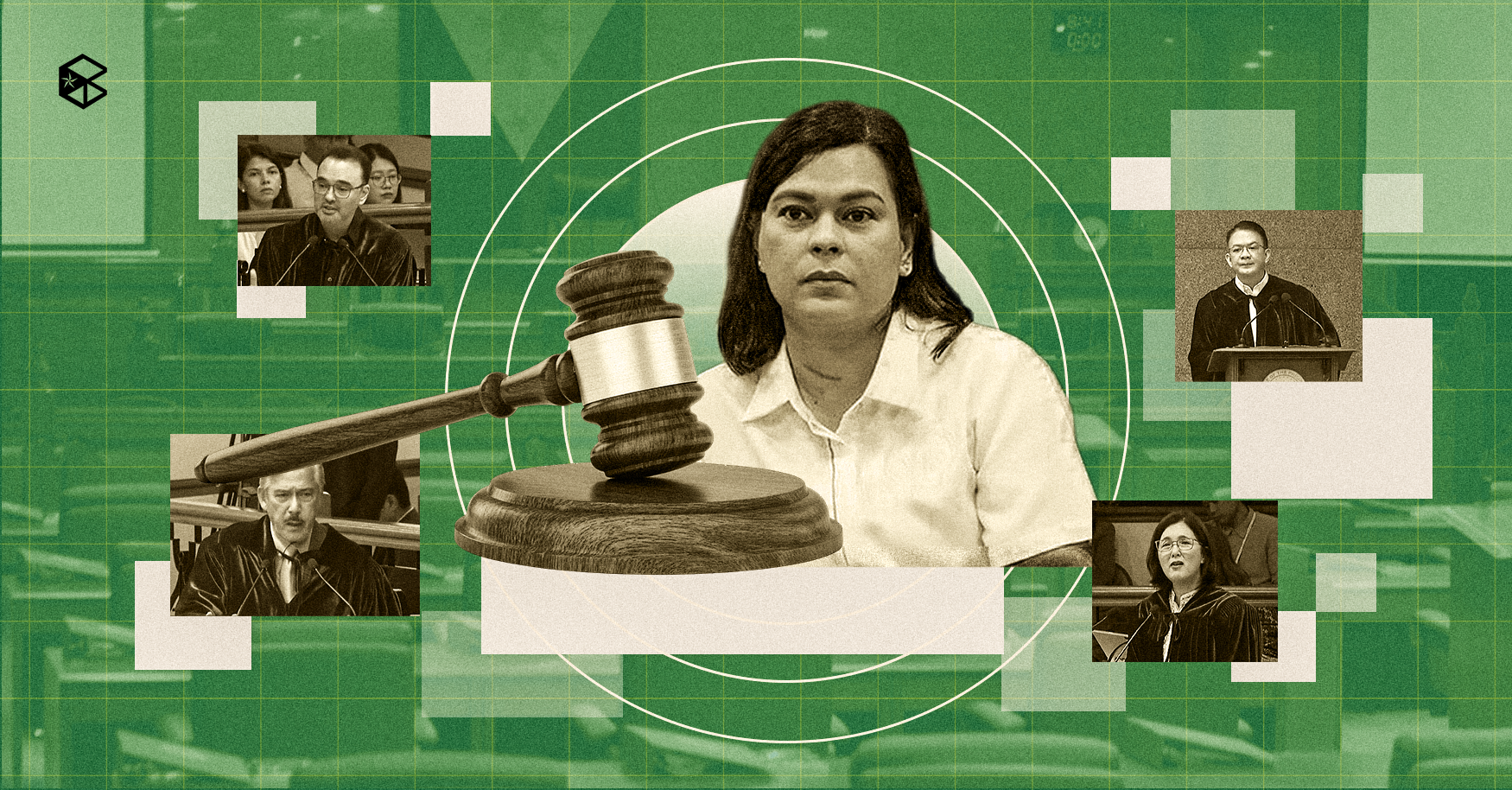




As Vice President Sara Duterte's impeachment trial entered its next phase, the proceedings evolved beyond a legal examination of the charges against her. Subpoena battles, witness testimonies, and courtroom exchanges placed the Senate under the same scrutiny, raising questions about how an impeachment court balances constitutional duty, judicial impartiality, and political realities.
Before the impeachment court ruled on the subpoena request, both parties devoted Day 6, July 15, to arguments over whether Duterte’s bank records, tax returns, and Anti-Money Laundering (AMLC) documents should be compelled as evidence for Article II, which alleged unexplained wealth.
The prosecution said that the records were necessary to establish Duterte’s financial activities, while the defense invoked protections on bank secrecy and tax confidentiality. On July 20, senator-judges deliberated on the request, including one involving Duterte’s husband, Manases Carpio, and their businesses.
The impeachment court granted the prosecution’s request to subpoena Duterte’s bank and tax records, citing precedent from the 2012 impeachment trial of former Chief Justice Renato Corona. Presiding Officer Senator Francis “Chiz” Escudero ruled that the requested records were prima facie relevant—meaning sufficient at first sight to support a claim—until later evidence disproved it and did not constitute a fishing expedition, authorizing subpoenas covering transactions from 2007 to 2021.
However, the court excluded Duterte’s foreign currency deposits under bank secrecy laws and denied requests involving JTC Group of Companies and Pikimong Philippines Corporation, corporate entities included in the prosecution’s subpoena request, for lack of sufficient evidence linking them to Duterte. Escudero also clarified that the subpoena issued to the Bureau of Internal Revenue (BIR) was merely a procedural step and did not automatically authorize the disclosure or admission of tax records into evidence.
The other trial
The hearing also underscored tensions within the impeachment court. Sen. Erwin Tulfo urged colleagues to set aside personal grievances and focus on the impeachment articles, prompting Sen. Alan Peter Cayetano to remark that legal issues were difficult to debate with non-lawyers. Sen. Vicente “Tito” Sotto III responded that, despite not being a lawyer, he had decades of experience as a legislator.
The exchange underscored one of the earliest tensions inside the impeachment court, not between the prosecution and the defense, but among the senator-judges themselves. While manifestations were part of Senate practice, the incident highlighted the challenge of balancing senators’ political instincts with their judicial role in an impeachment court, where prolonged debates unrelated to the evidence risked slowing proceedings and shifting attention away from the constitutional issues under review.
House prosecutor Chel Diokno welcomed the subpoena ruling as a step toward establishing the truth behind Duterte’s finances, while Defense spokesperson Michael Poa said the team had anticipated the decision and did not consider it a significant setback.
The hearing highlighted the delicate balance expected of senator-judges. Although they were empowered to question both parties to clarify legal issues, some exchanges drew public attention for closely resembling arguments advanced by the defense. The proceedings illustrated how the impeachment court’s credibility rested not only on its rulings but also on the perception that its members approach the trial with impartiality.
Words, action, and intent
On July 21, the prosecution presented NBI Director Melvin Matibag, who testified that Duterte’s public statements and those later made by Davao City Mayor Sebastian Duterte suggested a pattern that warranted investigation. Prosecutors also presented a video of Duterte, then Davao City mayor, punching a sheriff as evidence that they claimed demonstrated a “pattern of violence”.
When asked by Sen. Bam Aquino whether Duterte had spoken to a hitman, Matibag said he was “100%” certain she had spoken to someone based on her own public statements.
Matibag’s testimony reflected the prosecution's broader strategy of establishing a pattern rather than relying on a single incident. By presenting Duterte’s past public statements and conduct alongside the alleged assassination threats, prosecutors sought to frame Article IV, the alleged grave threats, as part of a continuing course of behavior instead of an isolated outburst.
Inside the withdrawals
On July 29, the prosecution shifted to Article I, the alleged misuse of confidential funds, presenting evidence on Duterte’s alleged misuse of ₱612.5 million in confidential funds. Former LandBank branch managers Violeta Constantino and Nenita Camposano testified that the Office of the Vice President and the Department of Education made unusually large cash withdrawals during Duterte’s tenure, including four ₱125 million checks that were reportedly carried out of the bank in gym bags.
While both witnesses described the transactions as unusual, they said the withdrawals were not classified as suspicious under banking procedures.
The prosecution argued that the testimonies corroborated claims made by former Duterte aide Ramil Madriaga regarding the movement of confidential funds. The defense declined to cross-examine Constantino, saying it did not dispute the authenticity of the checks, which the impeachment court later admitted into evidence.
Escudero also ruled that the prosecution must complete presenting evidence on all impeachment articles before the defense begins its case after both sides failed to agree on altering the order of presentation. House prosecutors said Commission on Audit officials assigned to audit intelligence and confidential funds would testify as hearings on Article I continued.
The court of public opinion
Outside the courtroom, the trial's political fallout continued. An ethics complaint was filed against Sen. Pia Cayetano over an allegedly spliced video of Diokno that critics said misrepresented the impeachment proceedings and undermined the integrity of the Senate sitting as an impeachment court.
The impeachment proceedings continued to shape public discourse. The ethics complaint illustrated how developments inside the trial increasingly spilled into the broader political arena, where statements made by both prosecutors and senator-judges became subjects of public scrutiny alongside the evidence itself.
As the trial progressed, the impeachment proceedings increasingly became a test not only of the evidence presented against Vice President Duterte but also of the Senate's ability to fulfill its constitutional role as an impeachment court. Procedural rulings, judicial conduct, and the manner in which senator-judges questioned both parties were scrutinized as closely as the witnesses themselves, underscoring that public confidence in the process depends as much on how the trial is conducted as on the verdict it ultimately reaches.
