
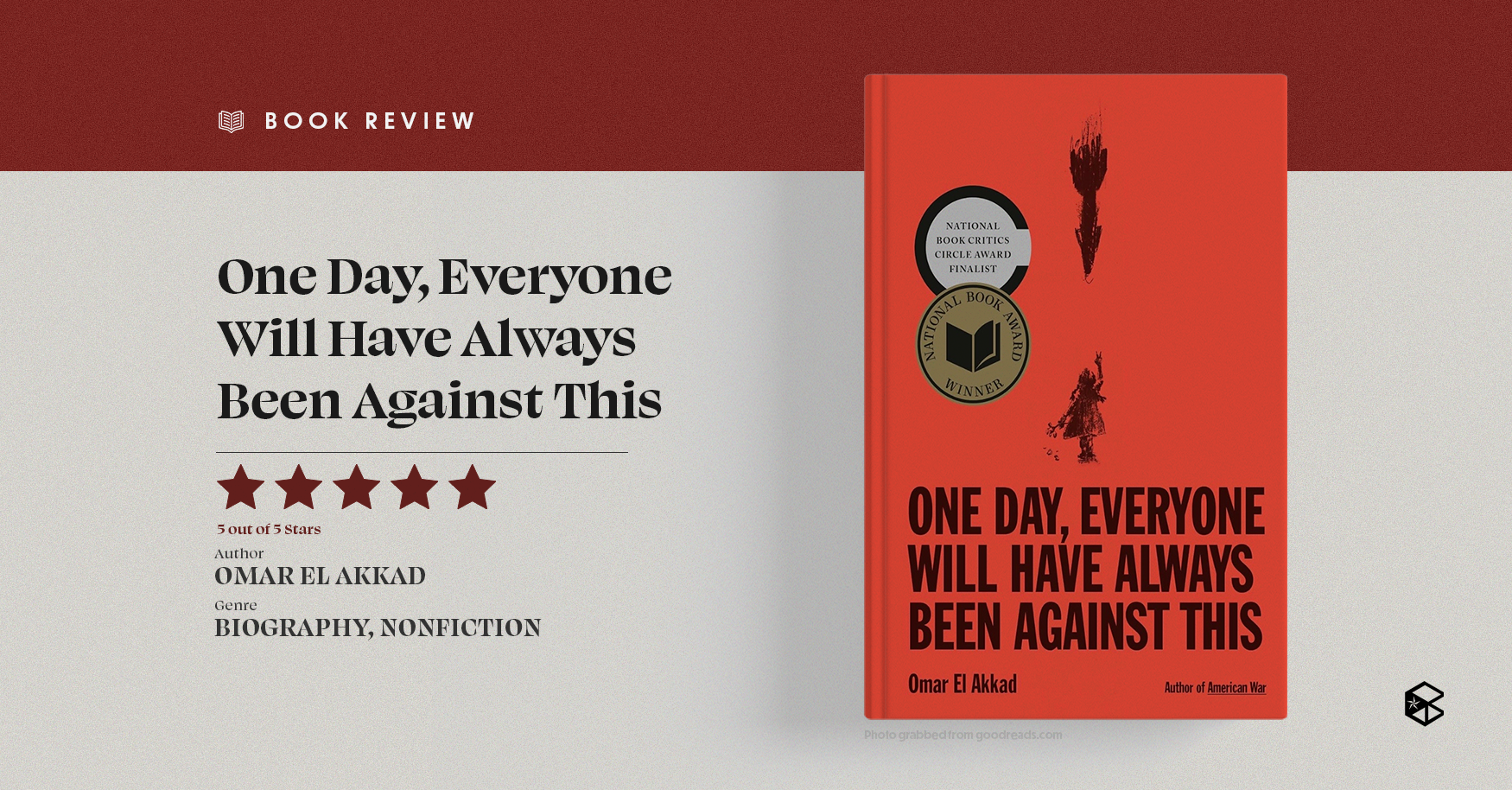




Title: One Day, Everyone Will Have Always Been Against This
Author: Omar El Akkad
Genre: Biography, Nonfiction
Personal Rating: 5/5
Omar El Akkad's One Day, Everyone Will Have Always Been Against This confronts this performance of moral righteousness, examining what it means to witness a genocide in real time and to live in a world that has found a thousand ways to justify its indifference.
There is a kind of cowardice in waiting for history to make the right thing obvious. In the face of injustice, our world has mastered the art of delayed outrage: carefully worded statements, retrospective condemnations, the sudden insistence that everyone had always known better. It is a book about Palestine, but also the formidable distance between knowing what is right and the courage to act accordingly.
Indifference as an imposition
Written against the backdrop of the genocide in Gaza, Palestine, the book interrogates the very systems that dictate whose suffering matters more, whose deaths are acceptable, and whose humanity must be proven before it is afforded protection. El Akkad exposes the contradictions of institutions that preach human rights and the sanctity of life, all while legitimizing ethnic cleansing through diplomacy and selective moral outrage.
The language of compassion
El Akkad does not allow the reader the comfort of treating this as someone else’s moral failure. His anger is directed not only at governments and institutions, but also at the ordinary mechanisms of denial that enable burgeoning injustice. The problem isn’t always that people don’t know what’s happening. Sometimes, people know perfectly well—they’ve just learned to live with it.
People have become remarkably compelling in the language of compassion, so long as compassion does not demand anything of us. El Akkad’s prose carries the exhaustion of someone who has witnessed the world repeatedly reveal its priorities. There is grief in this, but also a certain anger that refuses to be palatable. The book offers no easy catharsis or the reassurance that bearing witness is, by itself, sufficient to absolve us. Instead, El Akkad leaves us with the uncomfortable responsibility of deciding what we will choose to do with what we know now.
Afterlife of outrage
The title is particularly haunting because it speaks to a familiar historical ritual: the postmortem performance of morality. History is full of people who, after the fact, claim to have opposed the very things they tolerated, defended, or ignored while they were happening. The world is often much more comfortable condemning crimes against humanity once condemnation carries no cost. But what does it mean to be against something only when it has become safe? What good is a conscience that arrives only after mass graves have been buried?
One Day, Everyone Will Have Always Been Against This is not a comfortable read, nor should it be. Its urgency lies in the fact that the future it describes has yet to arrive. We are still, and have been, living in the present tense of atrocities, still making choices about what we are willing to witness and tolerate.
But one day, when there’s no personal downside to calling a thing what it is, when it's too late to hold anyone accountable, everyone will have always been against this.
One Day, Everyone Will Have Always Been Against This is available for purchase on Amazon and Fullybooked Online.
